AI tools for inventory management in retail business : For decades, inventory management was a defensive discipline. The goal was simple but elusive: avoid stockouts while minimizing carrying costs. You ordered based on last year’s sales, adjusted for gut feel, and prayed that the holiday rush wouldn’t expose your forecasting errors. Inventory was a necessary evil—capital trapped in warehouses, hoping to become revenue.
By early 2026, this paradigm has been permanently shattered. We have entered the era of autonomous inventory intelligence—systems that don’t merely track stock levels but predict demand at the individual SKU level, optimize pricing in real time, rebalance inventory across channels without human intervention, and even negotiate with suppliers autonomously .
The transformation is visible in the numbers. NVIDIA’s third annual State of AI in Retail and CPG survey reveals that 89% of retailers report AI is helping increase annual revenue, while 95% say it is helping decrease annual costs . More strikingly, 47% of retailers are already using or assessing agentic AI—systems that don’t just analyze but act—with autonomous agents handling real-time inventory rebalancing, dynamic pricing, and vendor negotiations at scale .
For retail business owners, this shift presents an unprecedented opportunity. The anxiety of “will we have enough stock for the holiday rush?” can be replaced by probabilistic forecasts that simulate thousands of scenarios. The manual work of spreadsheet-based reorder calculations can be eliminated. The guesswork of markdown timing can be optimized by AI that learns from every transaction.
This guide provides a strategic architecture for selecting and implementing AI inventory management tools in 2026. It is organized not by vendor popularity but by functional capability: from enterprise-grade platforms that orchestrate entire supply chains to specialized agents that optimize specific workflows, from physical AI that sees and sorts inventory to predictive systems that forecast demand with 99% accuracy.
Read More : AI tools for customer data analysis
AI based project management tools for teams
AI tools for HR and employee management
AI tools for sales funnel automation
AI video maker for Facebook ads
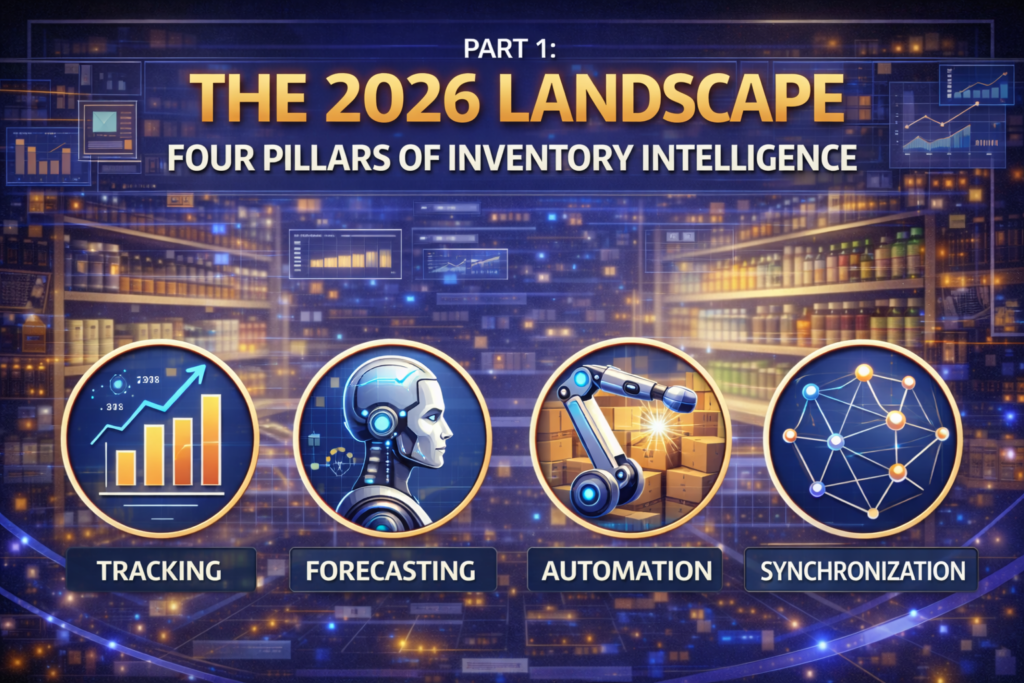
Part 1: The 2026 Landscape – Four Pillars of Inventory Intelligence
The Market Context
Retailers are moving decisively from AI experimentation to production-scale deployment. According to NVIDIA’s survey, 90% of respondents will increase their AI budgets in 2026, with half planning increases of 10% or more . This investment is being directed across four distinct but interconnected pillars:
Pillar 1: Demand Forecasting and Planning
Traditional forecasting looked backward. AI-powered forecasting looks forward—ingesting not just historical sales but also weather data, local events, social media trends, competitor pricing, and economic indicators to predict demand at granular levels.
Pillar 2: Inventory Optimization and Replenishment
Beyond forecasting, these systems determine optimal stock levels across locations, automate reorder decisions, and balance inventory across channels to minimize stockouts while reducing excess.
Pillar 3: Warehouse and Fulfillment Operations
Physical AI—systems that see, sort, and move inventory—is transforming warehouse operations. Computer vision tracks stock in real time; autonomous robots retrieve and pack orders; multi-agent systems orchestrate the entire fulfillment workflow .
Pillar 4: Vendor and Supplier Intelligence
The newest category: AI agents that monitor supplier performance, negotiate terms, and automatically adjust orders based on lead time reliability and cost fluctuations .
Part 2: The Enterprise Platforms – Orchestrating the Entire Inventory Lifecycle
SAP Retail Intelligence: The Closed-Loop Operating System
SAP’s January 2026 announcements at NRF represent the most comprehensive enterprise play for AI-powered inventory management. The company is infusing AI into the “DNA of every part of its retail solutions,” creating what it calls a “closed-loop, AI-enhanced retail operating system that ties planning, execution and engagement together” .
What It Delivers:
The Retail Intelligence solution within SAP Business Data Cloud provides accurate demand and inventory planning by leveraging retailers’ data from across SAP software and third-party systems . Purpose-built for retailers and direct-to-consumer businesses, it will be generally available in the first half of 2026.
The critical innovation is AI-generated simulations that let planners anticipate outcomes and optimize inventory before committing capital . Instead of running one forecast and hoping, planners can model thousands of scenarios—”what if a competitor discounts?” “what if shipping delays hit?” “what if this new product goes viral?”—and see probabilistic outcomes.
IDC Retail Insights analyst Ananda Chakravarty notes: “Retailers are seeking built-in, embedded AI solutions to help balance daily operations, future planning and agility to manage a dynamic market. What sets SAP apart is the holistic nature of its approach, offering an agentic operating system that works in the background, connects data and orchestrates agents” .
The Joule Copilot for Merchandising:
SAP also introduced AI-assisted assortment management allowing planners to create, modify, or retire assortments using natural language through the Joule copilot . This reduces the bottleneck on expert users, enabling faster responses to market shifts and freeing time for higher-value merchandising decisions.
Order Reliability Agent:
Planned for Q2 2026, this agent proactively identifies and resolves potential order issues, helping associates answer common questions about order status, stock availability, and fulfillment risks before they impact customers .
Strategic Consideration:
SAP’s solutions are built for enterprise-scale retailers with complex operations across multiple channels and regions. For smaller retailers, the complexity and cost may be prohibitive, but the architectural principles—unified data, AI-generated simulations, agentic orchestration—define the direction of the entire category.
NVIDIA’s Multi-Agent Intelligent Warehouse Blueprint: The Physical-Digital Bridge
While SAP focuses on planning and orchestration, NVIDIA is addressing the physical reality of inventory: warehouses filled with boxes, robots, and people, where problems emerge in seconds and visibility is often limited.
The Problem:
NVIDIA identifies a persistent gap in warehouse operations: the disconnect between Information Technology (IT) systems that track inventory and Operational Technology (OT) that runs the physical warehouse . This gap means managers can’t answer simple questions like “why is packaging slow?” without manual investigation.
The Solution:
NVIDIA’s Multi-Agent Intelligent Warehouse (MAIW) Blueprint, unveiled at NRF 2026, creates a synchronized AI system that spans existing warehouse management systems, enterprise resource planning, robots, and IoT data .
The blueprint consists of multiple specialized agents:
- Equipment asset management agents monitor machinery health and predict failures
- Collaborative operations agents coordinate workflows across workers and robots
- Safety and compliance agents ensure regulatory requirements are met
- Predictive analytics agents forecast bottlenecks before they occur
- Document processing agents handle paperwork and exceptions
These are unified by a central warehouse operations assistant that simulates how the warehouse actually runs and translates fragmented data into proactive decisions .
The Natural Language Interface:
A supervisor can ask: “Why is packaging slow?” The assistant analyzes equipment status, task queues, and staffing data, identifies the bottleneck, shows supporting evidence, and suggests optimizations like rebalancing workload or adjusting task priorities .
Production-Ready Features:
The blueprint includes role-based access controls and guardrails to ensure recommendations comply with policies, enabling teams to trust AI in physical equipment coordination and safety-critical decisions .
Partner Ecosystem:
Companies like Kinetic Vision, a product and technology development firm, are already building on the MAIW blueprint. CEO Jeremy Jarrett notes: “Charts and graphs are old. We need predictions and actionable paths forward. NVIDIA’s MAIW Blueprint will provide a more centralized way to answer questions and drive decisions” .
Strategic Consideration:
For retailers with physical warehouse operations, NVIDIA’s blueprint represents the current state of the art in connecting inventory data to physical reality. The open-source nature allows customization, but implementation requires technical capability.
Retail Catalog Enrichment: Solving the Data Sparse Problem
A parallel challenge in inventory management is the quality of product data itself. NVIDIA’s Retail Catalog Enrichment Blueprint addresses what it calls the “data sparse problem”—product images with little or inconsistent accompanying text, forcing teams to spend countless hours writing titles, descriptions, and attributes .
How It Works:
Using NVIDIA’s Nemotron vision-language models, the system takes a basic product photo—say, a ceramic mug—and automatically generates:
- Product metadata: color, material, capacity, style, use case
- Localized titles and descriptions for different markets
- Normalized attributes for search and recommendation systems
- Culturally appropriate 2D lifestyle images
- Interactive 3D assets
An AI “reviewer” checks outputs for quality and consistency .
Brand Voice Integration:
The blueprint applies brand voice, tone, and category specifications to product images and target markets, generating rich, on-brand content that improves both SEO and Generative Engine Optimization (GEO) .
Real-World Implementation:
Grid Dynamics, a global technology consultancy, has built a retail catalog enrichment system based on NVIDIA’s blueprint. CTO Ilya Katsov explains: “Search quality and customer browsing experience are only as good as catalog data quality. For all retailers with a digital presence, ensuring product attributes are as rich and consistent as possible is critical—and our solution automates this without human review” .
For large retailers with massive catalogs, missing or incorrect product attributes lead to inaccurate sales data, customer frustration, and loyalty erosion. Grid Dynamics’ solution applies AI-driven business rules at scale to improve data quality and present products customers actually want .
Strategic Consideration:
For any retailer with a digital catalog, this capability directly impacts discoverability and conversion. The technology is accessible at scale through NVIDIA’s open-source blueprint.
Part 3: The Agentic Commerce Layer – AI That Sells What You Have
The Shift from Search to AI Assistants
SAP’s vision for agentic commerce recognizes a fundamental shift: shopping journeys increasingly begin with AI assistants rather than storefronts or search engines . By 2026, retailers need to be present wherever buying decisions are made—including within ChatGPT and other AI platforms.
The Storefront MCP Server:
SAP announced a new storefront MCP server as part of SAP Commerce Cloud, enabling retailers to make their storefronts “intelligible to AI” . This creates a truly channel-less commerce experience where engagement, discovery, and transaction happen across human and AI-assisted touchpoints.
Retailers can now connect products, pricing, inventory, and promotions directly to AI-enabled discovery platforms like ChatGPT . When an AI assistant recommends a product, it does so with real-time inventory visibility, reducing the frustration of “recommended” items that are out of stock.
Strategic Consideration:
For retailers, this represents a new distribution channel. The question is no longer “how do we optimize our website for search?” but “how do we make our inventory visible to AI agents that consumers trust for recommendations?”
Part 4: The Predictive Intelligence Layer – Forecasting with Precision
Streamline: The Forecasting and Inventory Optimization Leader
While enterprise platforms like SAP provide comprehensive solutions, specialized tools like Streamline focus intensely on one problem: matching supply to demand with mathematical precision.
Documented Results:
Streamline, profiled in our earlier guides, continues to deliver industry-leading results:
- 99%+ inventory availability while simultaneously reducing excess
- 98% reduction in stockouts
- 50% reduction in excess inventory
- 1-5 percentage point margin improvement
- 56× ROI within one year, with payback in the first three months
The Technical Edge:
Streamline replaces static spreadsheet formulas with discrete event simulation, creating day-resolution schedules that model real-world inventory flow. Unlike ERP systems that trigger purchase signals per SKU individually, Streamline synchronizes order dates across product groups, enabling group-level economic order quantity optimization that traditional methods cannot achieve.
Integration Capabilities:
Bidirectional integration with SAP ERP, Oracle NetSuite, Microsoft Dynamics 365, QuickBooks, Shopify, and dozens of other systems makes Streamline accessible to retailers of all sizes.
Strategic Consideration:
For mid-market retailers with complex inventory needs, Streamline represents the most direct path to the 98% stockout reduction that separates industry leaders from also-rans.
Target’s AI Ambitions: Precision at Scale
At NRF 2026, Target’s EVP and Chief Information and Product Officer Prat Vemana outlined the retailer’s AI focus: “We’re expanding tools that help our teams spot trends earlier, plan inventory with more precision and create a more seamless shopping journey, from search to checkout” .
Target’s approach combines:
- Trend spotting: AI that identifies emerging patterns before they become obvious, enabling faster inventory positioning
- Precision planning: Granular demand forecasting at the store-SKU level
- Seamless fulfillment: AI that orchestrates inventory across channels to fulfill orders efficiently
Strategic Consideration:
For smaller retailers, the lesson is not to copy Target’s scale but to adopt its principles: trend detection, granular forecasting, and cross-channel orchestration are achievable with modern AI tools regardless of company size.
Part 5: The Physical AI Layer – Robots That See and Sort
The Rise of Physical AI in Retail
Physical AI—AI embedded in physical machines, sensors, robots, and smart devices—is rapidly gaining ground in retail operations. According to NVIDIA’s survey, 17% of retailers are already using or evaluating physical AI, with adoption accelerating as the technology matures .
What Physical AI Delivers:
Chris Walton, co-CEO of Omni Talk, explains: “The real transformation will come from AI that makes existing physical infrastructure smarter. My favorite example is in-store robotics. Through them, you get better pricing, better inventory management and better presentation quality” .
Applications in Inventory:
- Computer vision for shelf scanning: Cameras that continuously monitor shelf inventory, detecting out-of-stocks and planogram violations
- Autonomous mobile robots: Robots that navigate warehouses and stores, retrieving items and guiding workers to high-priority tasks
- Automated sorting systems: AI-powered conveyor systems that route products to the correct destination without human intervention
- Drone-based inventory counting: Aerial drones that scan warehouse racks, counting inventory in minutes rather than days
Strategic Consideration:
For retailers with physical stores or warehouses, physical AI represents the next frontier of inventory accuracy. The technology is no longer experimental; it is production-ready and ROI-positive for operations of sufficient scale.
Part 6: The Specialized Tools – Targeted Solutions for Specific Needs
Grainger’s KeepStock: Vendor-Managed Inventory Intelligence
Grainger, the industrial supply giant, has been expanding its KeepStock on-site inventory management program, which now serves as a case study in AI-powered inventory services .
What KeepStock Delivers:
Customers use KeepStock to control, track, and replenish frequently used maintenance, repair, and operations (MRO) supplies. The system includes:
- Barcode labeling and mobile scanning for easy reordering
- Configurable minimum and maximum stock levels
- Industrial vending machines at the point of use
- On-site support options for larger operations
The AI Layer:
Grainger has been developing new customer-facing KeepStock tools that provide “enhanced data and insights,” with a broader rollout planned for 2026 . These tools use machine learning to optimize stock levels based on usage patterns, lead times, and criticality.
Strategic Consideration:
For retailers managing high-volume, repetitive inventory, vendor-managed inventory programs with AI optimization layers can dramatically reduce administrative burden while improving availability.
Coresight’s Strategic Priorities: The Grocery Context
Coresight’s February 2026 analysis for grocery retailers identifies eight strategic priorities, several directly relevant to inventory management :
- Building agile supply chains through advanced demand forecasting, agentic AI for inventory replenishment, and data centralization
- Data-driven decision-making via retail analytics platforms and intelligent inventory visibility tools
- Maximizing operational efficiency with AI through AI agents and digital twins
Strategic Consideration:
Grocery retailers face unique inventory challenges—perishability, high SKU counts, thin margins. Coresight’s framework validates that AI forecasting and replenishment are no longer optional; they are table stakes for survival.
Part 7: The Implementation Discipline – From Chaos to Clarity
The Foundational Flaw
Retail TouchPoints’ February 2026 analysis delivers a crucial warning: “The best AI can’t sell what isn’t there. No AI-powered promotion or recommendation can save a sale if the product isn’t available. It doesn’t matter if your personalized promotion engine sends a tantalizing offer for an item that’s sitting in the wrong distribution center. Operational breakdowns negate technological breakthroughs, every single time” .
The Integration Imperative
The analysis continues: “Many retailers are over-investing in impressive, customer-facing tech while under-investing in the unglamorous but essential data integration that makes it work. A smart store is only as smart as the data that powers it” .
The Path Forward:
For retail leaders, the solution is not to spend more but to spend smarter: “Prioritize the connective tissue. Invest in platforms that unify your data. Empower your teams with a single source of truth. Close the gap between smart tech and core operations, and you won’t just survive 2026, you’ll define it” .
A 90-Day Implementation Framework
Phase 1 (Days 1-30): Assessment and Integration
- Audit current inventory data quality and system integration
- Identify the single biggest source of stockouts or excess
- Select one tool that addresses that specific pain point
- Connect the tool to your core systems (POS, ERP, e-commerce)
Phase 2 (Days 31-60): Pilot and Validation
- Run the tool alongside existing processes for one product category
- Measure accuracy improvements, time savings, and stockout reduction
- Collect feedback from inventory planners and store managers
- Refine configurations based on real-world performance
Phase 3 (Days 61-90): Scale and Optimize
- Expand to full inventory if pilot demonstrates ROI
- Establish ongoing monitoring and optimization cadence
- Document lessons learned for next category or capability
- Begin evaluating next priority area
Part 8: The Selection Matrix – Matching Tool to Business Reality
Scenario A: The Small Independent Retailer (1-5 locations)
Primary Constraint: Budget and technical complexity
Secondary Constraint: Time
Recommended Approach: Start with demand forecasting through existing POS analytics or affordable tools like Streamline’s entry tiers. Focus on solving one problem—stockouts of top 20% SKUs—before expanding.
Budget Range: $500-2,000/month
Scenario B: The Regional Chain (5-50 locations)
Primary Constraint: Multi-location coordination
Secondary Constraint: Channel integration (store + e-commerce)
Recommended Approach: Deploy a unified inventory platform that provides real-time visibility across locations. Evaluate Streamline for forecasting and replenishment, and begin exploring NVIDIA’s blueprint concepts for warehouse optimization.
Budget Range: $2,000-10,000/month
Scenario C: The Enterprise Retailer (50+ locations, multiple channels)
Primary Constraint: Scale and complexity
Secondary Constraint: Speed of execution
Recommended Approach: SAP Retail Intelligence for enterprise-wide orchestration, NVIDIA MAIW for warehouse operations, and specialized tools for specific categories. Invest heavily in data unification and integration infrastructure.
Budget Range: Enterprise pricing; typically $50,000+/month for comprehensive deployment
Scenario D: The E-Commerce Pure Play
Primary Constraint: Inventory visibility across fulfillment centers
Secondary Constraint: Returns management
Recommended Approach: Focus on real-time inventory synchronization across warehouses and marketplaces. Catalog enrichment tools are particularly valuable for improving discoverability and conversion.
Budget Range: $1,000-5,000/month depending on catalog size
Part 9: The Future Trajectory – From Reactive to Predictive to Autonomous
The Agentic Commerce Horizon
The truly disruptive impact of agentic AI will hit retail supply chains and operations first. As Chris Walton notes, “autonomous agents handling real-time inventory rebalancing, dynamic pricing and vendor negotiations at scale” are already being deployed by leading retailers .
The Timeline:
- 2024-2025: AI forecasting and recommendations
- 2026-2027: Autonomous inventory rebalancing across channels
- 2028+: Fully autonomous supply chains with minimal human oversight
The Strategic Imperative
Retail leaders face a clear choice: build the capability to orchestrate AI agents across their inventory operations, or watch competitors build it while you remain tethered to spreadsheets and manual processes.
As Sampath Saagi of Tech Mahindra concludes: “2026 will be a referendum on operational intelligence. The data shows a near-universal ambition among retailers to modernize, but it also reveals a persistent and costly gap between that ambition and day-to-day execution” .
Conclusion: AI tools for inventory management in retail business
The 2026 AI inventory management landscape is no longer a collection of interesting experiments. It is a mature, structured market with clear categories, proven ROI, and accelerating adoption.
The distinction that separates successful from struggling retailers is no longer “Do we use inventory software?” It is “Have we architected our inventory operations around autonomous intelligence?”
Successful retailers do not ask “Which inventory tool should we buy?” They ask “Which inventory workflows, if redesigned around autonomous agent capabilities, would deliver the greatest value in stockout reduction, excess elimination, and working capital freed?”
They do not ask “How do we get our team to use this software?” They ask “How do we retrain our inventory planners from order placers to exception managers?”
They do not ask “Is this platform secure?” They ask “Does this platform provide the real-time visibility, auditability, and control we need to trust autonomous inventory decisions?”
The tools profiled in this guide—SAP for enterprise orchestration, NVIDIA for physical-digital integration, Streamline for forecasting precision, and the specialized solutions for catalog enrichment and vendor management—represent the current state of the art.
But the art is advancing rapidly. The retailers that win in the next five years will be those that recognize AI inventory management is not a technology replacement project. It is an operational redesign project. It requires rethinking not just how inventory is tracked, but how demand is predicted, how stock is positioned, how fulfillment is executed, and how value is delivered.
The tools are ready. The integration pathways are mapped. The ROI data is unambiguous.
The only remaining variable is whether you will build this inventory architecture with strategic intention—or continue operating with fragmented data and manual processes while your competitors deliver 99% availability, 98% fewer stockouts, and margins your P&L has never seen.
