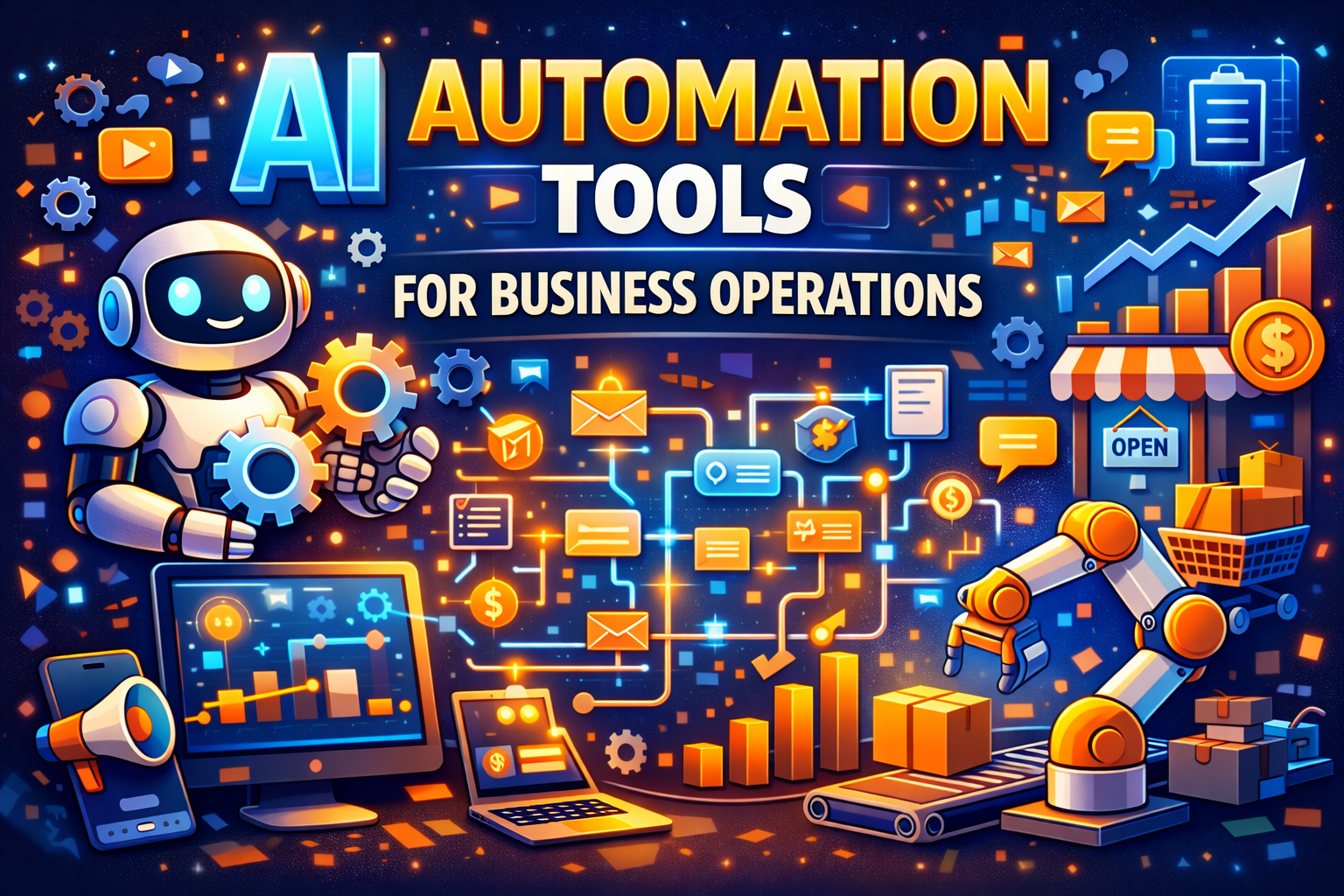
AI Automation Tools for Business Operations : The terminology itself has become obsolete. For the past decade, business leaders have spoken of “AI tools”—software applications that assist human workers by automating discrete tasks, generating content, or providing analytical insights. This framing, however comforting in its familiarity, fundamentally misunderstands what has occurred in the eighteen months between late 2024 and early 2026.
We are no longer adding tools to our organizational chart. We are adding employees.
These employees do not sleep, do not require benefits, and can scale from one to one thousand instantaneously. They are the AI agents now deployed by over 78% of mid-market companies across at least three production-grade functions . They are the multi-agent systems orchestrating supply chain decisions, financial forecasting, and IT service management . They are the “digital coworkers” that OpenAI’s Frontier platform manages across enterprises like Cisco, T-Mobile, and Uber .
The shift from “automation tools” to “autonomous agents” is not semantic. It represents a fundamental re-architecting of how business operations function. Traditional automation—robotic process automation, workflow engines, rules-based systems—executed predefined sequences. If the process deviated from the expected path, the automation failed and a human intervened. The system did not think; it followed.
Agentic AI observes, decides, executes, and validates. It reasons across disconnected data sources, selects appropriate actions, performs those actions within enterprise software environments, and verifies the outcomes—all without human prompting . Organizations deploying these systems are achieving productivity gains of three to five times, not through marginal efficiency improvements but through the complete elimination of manual handoffs, reconciliation labor, and decision delays .
This guide is not a catalog. It is an architectural blueprint. Drawing from verified implementation data across logistics, manufacturing, financial services, and professional services firms, we examine how AI automation tools are being deployed not as experiments but as core operational infrastructure. We analyze the platforms that enable this transformation, the specific workflows where agentic systems deliver measurable ROI within 90 days, and the governance frameworks required to scale these digital workforces safely.
The era of the AI-augmented worker is here. The era of the AI-led operation is arriving faster than most executives anticipate.
See More : AI Video Creation Tool For Faceless YouTube Channels
Part 1: The Architectural Shift – From Workflow Automation to Agentic Orchestration
The Failure of Traditional Automation
The past decade of digital transformation has left a sobering legacy: despite massive investment in CRM, ERP, RPA, and business process management suites, human workers remain the primary connective tissue between enterprise systems . A sales opportunity moves from marketing automation to the CRM, then to a forecasting spreadsheet, then to a contract management system, then to billing. At each transfer point, a human exports, transforms, reconciles, and imports data. These handoffs are not value-adding activities; they are tax on complexity.
Traditional automation attempted to address this through rigid workflows. If Condition A occurs, execute Action B. This approach functions adequately in stable, predictable environments. It collapses when exceptions arise—which, in real business operations, is constant.
The 2026 benchmark report from Automatic.co, based on deployments across mid-market and enterprise organizations, quantifies this failure: even modern automation platforms remain “brittle, relying on predefined workflows and human oversight when exceptions occur” . The result is “operational drag: work slows down as tickets wait in queues, data must be reconciled, and decisions are delayed across organizational silos” .
Agentic AI: The Reasoning-to-Action Loop
Agentic systems differ fundamentally from both human-performed work and rules-based automation. They operate through what Automation Anywhere terms the “reasoning-to-action loop”: AI models for reasoning and interpretation, coupled with governed execution engines that perform actions within enterprise environments .
This architecture enables four capabilities that distinguish agentic systems from their predecessors:
- Observation: Agents continuously monitor data streams, system states, and user behaviors without requiring explicit triggering events.
- Reasoning: When deviations, opportunities, or requests are detected, agents evaluate possible responses against learned patterns, organizational policies, and outcome objectives.
- Execution: Agents perform actions directly within enterprise software—updating records, triggering workflows, initiating communications—using APIs and integration frameworks.
- Validation: Agents verify that executed actions achieved intended outcomes and, when they did not, either self-correct or escalate with full context to human supervisors.
This is not robotic process automation. RPA mimics human keystrokes and clicks. Agentic AI understands the intent behind the action, the context surrounding it, and the criteria for success.
The Multi-Agent Paradigm
The most significant architectural development of 2026 is the mainstream adoption of multi-agent systems. Rather than a single large language model handling isolated question-answer tasks, organizations now deploy groups of AI agents that “plan, think, check their work, and execute tasks together” .
These agent collectives are replacing traditional workflow tools, RPA bots, and fixed-rule systems across financial analysis, supply chain orchestration, IT service management, and customer support . In production environments, agents negotiate task assignments, verify each other’s outputs, enforce permission boundaries, and escalate exceptions—”with a considerable amount of autonomy” .
The implications for business operations are profound. Workflows that previously required sequential handoffs between departments can now be executed as parallel, coordinated activities. A customer’s contract renewal, for example, might simultaneously engage: a sales agent verifying opportunity status, a legal agent reviewing updated terms, a finance agent validating payment history, and a fulfillment agent confirming delivery capacity—all coordinated through a shared context and orchestration layer .
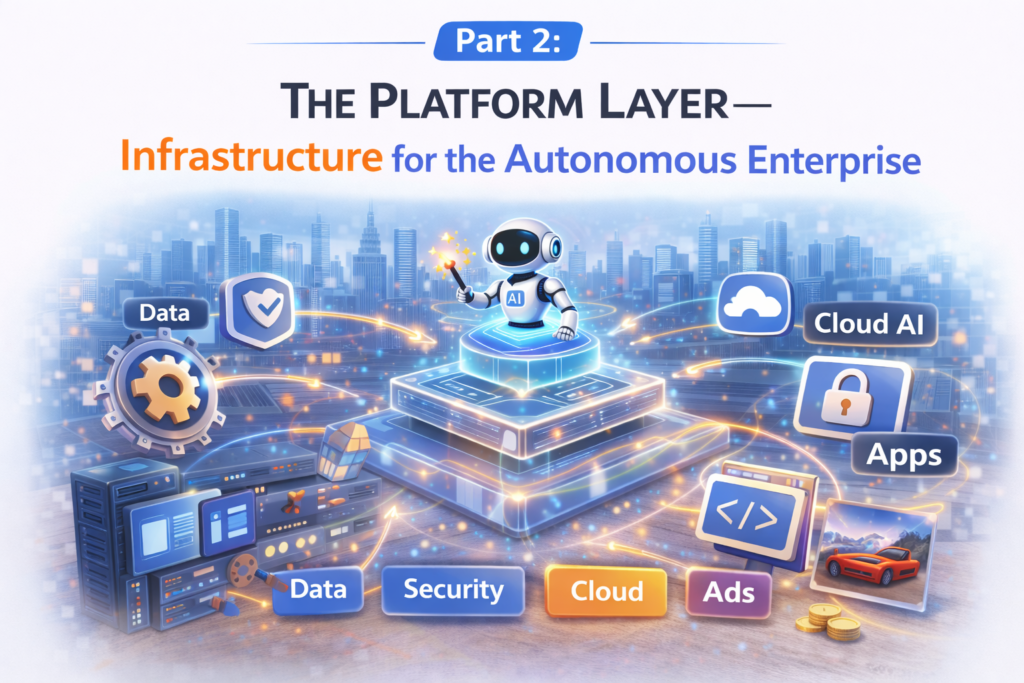
Part 2: The Platform Layer – Infrastructure for the Autonomous Enterprise
The proliferation of point solutions has created a new bottleneck. Organizations that successfully deployed three, five, or ten AI agents across different departments quickly discovered that each agent operated in isolation, with “no shared state, no centralized policy, and no cross-agent awareness” . The result was a new form of fragmentation: AI silos.
Enterprise AI platforms have emerged to address this fragmentation. They function as the “control plane” for organizational AI, standardizing how agents are deployed, how they connect to systems, how risk is managed, and how performance is measured .
Kore.ai: The Multi-Agent Orchestration Specialist
Kore.ai has positioned itself as the leading platform for enterprises operationalizing AI agents at scale across customer experience, employee experience, and business processes . Its multi-agent orchestration engine enables multiple AI agents to “collaborate, hand off context, and execute tasks with differing levels of autonomy—from simple assistive copilots to fully autonomous task-executing agents” .
The platform’s architecture is intentionally agnostic—model-agnostic, cloud-agnostic, and data-agnostic—allowing enterprises to “choose any LLM they prefer, including bringing their own in-house models, running them in any environment, and connecting to virtually any data source” . This flexibility directly addresses the “lock-in” concern that has inhibited enterprise-scale AI adoption.
Kore.ai‘s governance dashboard provides “full visibility into every agent’s decisions, actions, and performance,” with end-to-end tracing, audit logs, and real-time monitoring . For regulated industries and compliance-sensitive operations, this observability is not a feature but a prerequisite. The platform is trusted by over 400 Fortune 2000 companies and has delivered more than $1 billion in documented cost savings .
OpenAI Frontier: The Enterprise Orchestration Layer
OpenAI’s February 2026 launch of Frontier represents the company’s strategic pivot from model provider to enterprise infrastructure vendor . Frontier addresses what analysts identify as the central challenge of enterprise AI adoption: “Enterprises aren’t struggling with AI models. They’re struggling with deploying agents reliably, safely, and consistently” .
Frontier operates as a central resource that “knits together various disparate AI agents in use across an enterprise via shared context, onboarding, hands-on learning with feedback and clear permissions and boundaries” . Critically, it is compatible with existing systems and can manage not only OpenAI-developed agents but also those “created in-house and by third parties” .
Early adopters include HP, Intuit, Oracle, State Farm, Thermo Fisher, and Uber, with BBVA, Cisco, and T-Mobile conducting pilots . Frontier’s emergence signals that the competitive battleground in enterprise AI has shifted from model capability to orchestration capability.
Automation Anywhere: Agentic Process Automation
Automation Anywhere has redefined its twenty-year legacy in robotic process automation through its Agentic Process Automation (APA) system, developed in collaboration with OpenAI . The platform’s Process Reasoning Engine (PRE) “determines what enterprise action should happen next and securely orchestrates work across systems,” while OpenAI’s reasoning models handle interpretation and planning .
The critical innovation is the deliberate blending of “agentic reasoning, deterministic execution, and human judgment into a single, governed flow” . This addresses the common failure mode of agentic initiatives: systems that are either “too autonomous or too constrained.” By maintaining human-in-the-loop controls for high-stakes decisions while enabling full autonomy for routine operations, Automation Anywhere has achieved production reliability that pure-agent systems often lack.
Decisions: The Low-Code Orchestrator
For organizations seeking to empower business users rather than centralize AI development in IT, Decisions offers a low-code platform with strong no-code capabilities . Its visual designer studio enables business users to “design, update, and manage rules and workflows using intuitive, no-code tools—giving them direct control over the logic they know best” .
Decisions distinguishes itself through its native rules engine, which allows organizations to “create and manage business logic without code using decision tables, rule sets, and more” . This is particularly valuable for organizations operating in dynamic regulatory environments where policies change frequently and must be implemented without engineering cycles.
The platform’s Process Mining capability “turns your data into a visual map of how processes actually run—revealing inefficiencies, deviations, and delays” . For organizations unsure where to begin their automation journey, this diagnostic capability provides empirical direction rather than intuition-based guessing.
IBM Enterprise Advantage: The Systems Integrator Approach
IBM has taken a different approach, recognizing that for many large enterprises, the challenge is not selecting AI tools but integrating them into complex, heterogeneous technology estates. IBM Enterprise Advantage is an “asset-type consulting service” that helps enterprises “quickly build, compliantly govern, and scale the operation of their own customized internal AI platform” .
The service is built on IBM’s internal AI-driven delivery platform, which has been “battle-tested in over 150 client projects, improving consultant productivity by up to 50%” . For organizations lacking internal AI engineering capacity—which describes the vast majority of enterprises—this model provides a path to capability without requiring headcount expansion.
Part 3: Operational Domains – Where Agentic Systems Deliver Measurable ROI
Supply Chain and Logistics
The logistics sector has emerged as the proving ground for agentic AI in operations, and for good reason: supply chains generate massive volumes of heterogeneous data, operate under constant uncertainty, and require rapid decisions with significant financial consequences.
Tecton Flow, a predictive analytics and constraint-based optimization platform, exemplifies the agentic approach to supply chain operations . It does not simply forecast demand; it “simulates how disruptions (port delays, supplier shortages, weather events) cascade across your network and recommends actionable trade-offs: ‘Delay shipment A by 2 days to avoid $84K in expedited freight; reroute via Dallas instead of Chicago'” .
A national food distributor using Tecton Flow achieved a 28% reduction in stockouts while simultaneously reducing safety stock levels by 14%—an unusual combination that demonstrates the platform’s ability to optimize for competing objectives . The 2026 update adds carbon-aware routing, factoring “emissions per mile and grid intensity into delivery planning,” enabling organizations to meet Scope 3 reporting requirements while managing costs .
The Nexus Logistics case study provides granular implementation data . A regional 3PL serving 120+ SMB manufacturers faced rising fuel costs and customer demands for real-time ETAs. Their legacy transportation management system offered static routing and manual exception handling, resulting in 22% late deliveries and $1.4 million in annual penalty fees.
Tecton Flow was integrated alongside their existing SAP TM module following a deliberate sequence: ingestion of 18 months of historical route, carrier performance, and weather data; simulation of “status quo” versus dynamic alternatives; and API integration into the driver app for real-time route optimization and delay alerts.
Results after 90 days: on-time deliveries rose to 94% (from 78%), penalty fees dropped by 68%, and fuel consumption per mile fell 11%. Dispatchers reported spending 50% less time managing exceptions, freeing capacity to proactively engage customers about potential delays before they occurred .
Finance and Revenue Operations
Finance departments have historically been conservative adopters of automation, constrained by audit requirements, regulatory oversight, and the existential consequences of error. Agentic systems have penetrated this domain not despite these constraints but because they offer superior auditability and control compared to manual processes.
Finova Forecast replaces static Excel models with adaptive scenario engines that “ingest ERP data, market indices, FX rates, and even unstructured inputs like earnings call transcripts (using sentiment-weighted NLP)” . Rather than presenting “best/worst case” scenarios, it generates probabilistic forecasts: “There’s a 72% chance revenue hits $42.1M ±$1.3M in Q3, driven primarily by APAC channel growth and FX volatility” .
The “Assumption Audit Trail” feature allows finance leaders to “trace every forecast variable back to its source”—critical for SOX compliance and board reporting . A manufacturing client using Finova improved budget accuracy (versus actuals) by 29 percentage points year-over-year.
For smaller organizations without dedicated FP&A teams, Futrli and Fluidly offer accessible AI forecasting integrated with Xero and QuickBooks . These tools analyze historical data, identify patterns, and predict future performance, flagging potential cash flow crunches weeks before they materialize. A business owner can run scenarios—”What happens to cash flow if we hire two people in Q2?”—and receive probabilistic projections within minutes.
Automatic.co‘s 2026 benchmark found that agentic systems in finance operations delivered among the highest productivity gains, with autonomous agents executing “real-time invoicing, reconciliation, and reporting” without human intervention . Organizations reduced manual work while improving consistency and accuracy—a combination that traditional trade-off frameworks considered impossible.
Customer Service Operations
Customer service has been the vanguard of AI adoption for years, but the 2026 landscape bears little resemblance to the chatbot experiments of 2023. The shift is from conversational AI that answers questions to agentic AI that resolves issues.
Intercom’s Fin AI Agent resolves common issues autonomously, while Zendesk AI’s Advanced AI add-on ($50 per agent monthly) provides sophisticated intent recognition and routing . For scaling businesses, Tidio offers an accessible entry point, handling FAQs and basic troubleshooting with minimal configuration .
The strategic shift is evident in how these tools are deployed. Rather than treating AI as a deflection mechanism—keeping customers away from human agents—leading organizations use agentic systems to resolve complete workflows. A customer reporting a lost package does not receive a tracking link; the agent verifies the order status, confirms delivery exceptions, initiates a claim, and schedules a replacement—all within the same interaction.
The productivity impact is substantial. Automatic.co‘s benchmark found that organizations deploying autonomous agents in customer operations achieved “automated ticket resolution and escalation handling” that reduced manual touchpoints by over 70% .
Sales and Revenue Operations
Sales operations have historically been characterized by friction: leads delayed in routing, proposals awaiting approval, contracts cycling through redline negotiations. Each delay reduces conversion probability.
Looma.ai has emerged as a leader in this domain through its “contextual memory engine,” which ingests CRM history, support tickets, product documentation, and recorded customer calls to generate “hyper-personalized next-best-action suggestions” . Its Co-Pilot Mode operates as a sidebar in Slack or Teams, surfacing relevant knowledge “as agents type, with citations back to source documents” .
A B2B SaaS company integrating Looma with Zendesk and Gong achieved a 37% reduction in average handle time for Tier 2 support and a 19% increase in upsell conversion . These are not marginal improvements; they represent categorical shifts in operational capability.
Legal and Compliance
ClarityDocs represents a new category of agentic system for legal and compliance operations . It reads contracts in context, “understanding jurisdiction-specific implications, identifying hidden obligations (e.g., ‘data deletion upon termination’ buried in an appendix), and benchmarking terms against industry standards” .
Its 2026 “Risk Radar” feature “highlights clauses that conflict with new regulations—like GDPR Article 28 updates or SEC cybersecurity disclosure rules—flagging them with severity scores and remediation steps” . A global pharmaceutical company using ClarityDocs reduced contract review time by 62% and compliance-related rework by 49%.
This is not automation of existing workflows; it is the enablement of workflows that were previously impossible at scale. No organization could manually benchmark every contract clause against industry standards or continuously monitor executed agreements against evolving regulatory requirements. Agentic systems perform these functions continuously, automatically, and exhaustively.
Part 4: The Talent and Governance Imperative
The Human-in-the-Loop Reconsidered
The rhetoric surrounding autonomous AI has created considerable anxiety about job displacement. The empirical evidence suggests a more nuanced reality. Organizations achieving the highest returns from agentic AI are not those that eliminate human roles but those that redesign them.
Automatic.co‘s benchmark found that “what surprised us wasn’t that clients became more efficient—it was how quickly entire roles became unnecessary” in sales operations, finance operations, and marketing operations . Yet the same report notes that these organizations did not necessarily reduce headcount; they reallocated human talent from transactional work to strategic activities, from execution to improvement.
This distinction is critical. An organization that eliminates manual data reconciliation and reallocates those employees to customer relationship development has not reduced employment; it has upgraded the value of its workforce.
The AI Steward Role
Every successful enterprise-scale AI deployment shares a common organizational feature: the designation of an “AI Steward” or equivalent role . This is typically a power user from the pilot team, not a technical specialist, who dedicates 4-6 hours weekly to “maintaining quality, documenting decisions, and scaling best practices” .
The AI Steward functions as the bridge between business operations and AI platform capabilities. They monitor agent performance, refine prompts and rules, onboard new team members, and serve as the internal expert on what the organization’s AI systems can and cannot do.
Vendor-provided certification programs, many of which are free, enable this role without requiring external hiring . For organizations concerned about AI talent scarcity, internal upskilling is not a compromise; it is best practice.
Governance at Production Scale
The shift from pilots to production-scale AI operations introduces governance requirements that most organizations have not yet addressed. Kore.ai‘s governance dashboard represents the emerging standard: “end-to-end tracing, audit logs, and real-time monitoring so enterprises can deploy AI safely, transparently, and at scale” .
Critical governance capabilities include:
Role-Based Access Control (RBAC): Agents must operate with the same permission boundaries as human employees. An agent handling customer service inquiries should not have access to financial records. RBAC frameworks enforce these boundaries systematically .
Audit Logs: Every action taken by an agent, every decision it made, and every input it received must be recorded in immutable, timestamped logs. This is not optional for regulated industries .
Guardrails: Configurable restrictions that “enforce organizational policies, restrict unsafe behaviors, and manage permissions” . Guardrails operate at the behavioral level, not just the access level—preventing agents from making commitments the organization cannot fulfill, using language inconsistent with brand voice, or offering discounts beyond authorized thresholds.
Observability: Real-time monitoring of agent performance, including success rates, error rates, and response times. When agents behave unexpectedly, observability tools enable rapid diagnosis and correction .
Organizations that scale AI without these governance capabilities are accumulating technical debt that will eventually require remediation. Organizations that build them into their initial architecture are future-proofing their operations.
Part 5: Implementation Methodology – From Pilot to Scale
The 90-Day Value Thesis
The most reliable predictor of successful AI automation adoption is not the sophistication of the technology but the discipline of the implementation methodology. Organizations that achieve production-scale value within 90 days follow a consistent pattern.
Week 1-2: Anchor Workflow Identification
Select one high-friction, high-volume workflow with clear start and end points and measurable KPIs . Do not attempt to transform customer service operations; automate responses to the five most common shipping policy questions. Do not overhaul the entire order-to-cash process; automate PO receipt to payment approval.
Document current state meticulously. Measure cycle time, error rate, labor cost, and customer satisfaction. Interview the three to five people most intimately involved in the workflow. Understand not just what they do but why they do it.
Week 3-4: Tool Selection and Integration Validation
Evaluate tools against your specific workflow, not against generic capability rankings. Confirm integration feasibility with your IT team: do required APIs exist? Do authentication methods align? Do data residency requirements match?
Run a technical proof of concept with real data—not synthetic test cases—to validate that the tool can handle the complexity, volume, and exceptions characteristic of your actual operations.
Week 5-8: Pilot Deployment with Real Users
Deploy the system to a single team member or limited transaction volume. Establish the human validation protocol: what percentage of outputs will be reviewed? Under what conditions should the agent escalate rather than act independently?
Collect qualitative feedback continuously. What is working? What is frustrating? What edge cases were not anticipated? Refine prompts, retrain models, or modify workflows based on this feedback.
Week 9-12: Measurement and Scaling Decision
Calculate actual time savings versus baseline. Survey users on satisfaction and confidence. Quantify error rate reduction and speed improvement.
If the pilot demonstrates clear ROI—minimum 15% improvement in core KPIs—expand to full team or full transaction volume . If results are inconclusive, extend the test with clearer success criteria. If the pilot is failing, kill it. Document lessons learned and move to the next candidate workflow.
The Integration Imperative
The single greatest cause of failed AI automation initiatives is not technology inadequacy but integration debt. Organizations underestimate the effort required to connect AI systems to the enterprise software environments where work actually occurs.
Leading platforms have responded by developing mature integration frameworks. Kore.ai offers 250+ “enterprise-grade, plug-and-play integrations” giving agents direct access to CRM, ITSM, HRIS, ERP, and data lakes . Decisions positions itself as an “orchestration layer” that “connects legacy systems, modern apps, and APIs to orchestrate unified operations, workflows, and data” .
Before committing to any platform, validate that it offers native, bidirectional synchronization with your core systems: Microsoft 365, Salesforce, NetSuite, ServiceNow, Workday, or SAP . If the platform requires custom API development for each integration, you have not purchased a solution; you have purchased a project.
Part 6: The Emerging Frontier – Vertical AI and Physical Operations
Vertical Specialization
The 2026 trend analysis is unequivocal: general-purpose LLMs are being supplanted by “customized and tuned models for specific industrial data and rules” that deliver “higher accuracy, relevance, and trustworthiness” .
This verticalization is most advanced in healthcare (patient triage, claims automation), financial services (fraud detection, risk modeling), pharmaceuticals (trial simulation), and retail (hyperlocal demand sensing) . In each domain, organizations are discovering that general models, trained on the entire internet, underperform specialized models trained on industry-specific data with industry-specific ontologies.
For business operations leaders, this trend has a clear implication: do not default to the most prominent AI vendor. Investigate vertical-specific platforms that have been trained on data from your industry and configured for your regulatory environment. The accuracy differential is not marginal; it is the difference between production-ready and pilot-perpetual.
Physical AI
Digital transformation’s final frontier is the physical world. Physical AI—the integration of AI into “physical machines, sensors, robots, and smart devices”—is still nascent but accelerating rapidly .
In manufacturing, AI-powered computer vision systems now achieve 80% inspection accuracy at 0.1 seconds per component, a 66% speed increase over human inspectors . In logistics, autonomous mobile robots navigate warehouses alongside human workers, dynamically rerouting based on real-time order volumes and congestion patterns.
For most business operations leaders, Physical AI remains a future consideration rather than an immediate investment priority. But the trajectory is clear: the separation between digital operations and physical operations is eroding. Organizations that treat them as distinct domains will be disadvantaged against competitors that integrate them.
Conclusion: From Efficiency to Autonomy
The AI automation tools profiled in this guide represent more than incremental improvement over previous generations of business software. They represent a categorical shift in what it means to operate an enterprise.
Organizations that deploy agentic systems are not simply performing existing work faster. They are performing work that was previously impossible—continuously monitoring supply chains for disruption vectors they did not know existed, benchmarking every contract clause against evolving regulatory requirements, forecasting financial outcomes with quantified probabilities rather than single-point guesses.
The productivity gains documented in this guide—three to five times improvement, 94% on-time delivery, 62% reduction in contract review time—are not marginal. They are transformational. They alter the competitive economics of entire industries.
Yet these gains are not automatic. They require deliberate methodology: anchor workflow identification, rigorous baseline measurement, integration validation, pilot deployment with real users, and governance frameworks that scale with adoption. They require organizational redesign: AI stewards, upskilled workforces, and human roles reoriented from execution to judgment.
The organizations winning with AI automation in 2026 share one characteristic: they have stopped treating AI as a technology project and started treating it as an operational strategy. They do not ask “What can AI do?” They ask “What work should we redesign around AI’s capabilities?” They do not measure AI adoption rates. They measure ROI, cycle time reduction, error rate elimination, and employee satisfaction.
The tools are ready. The integration pathways are mapped. The governance frameworks are defined. The only remaining variable is organizational commitment to the disciplined, methodical work of operational transformation.
The autonomous enterprise is not a future state. It is a present possibility. The question is whether your organization will build it or watch competitors build it around you.

1 thought on “AI Automation Tools for Business Operations”