AI tools for online store optimization : For the past twenty years, optimizing an online store followed a predictable but deeply inefficient pattern. You launched your site, waited for traffic, guessed at what might improve conversion rates, ran manual A/B tests that took weeks to reach statistical significance, and implemented changes based on intuition as much as data. If you were sophisticated, you hired an agency to manage this process. If you were a small business, you likely did nothing—leaving significant revenue on the table because true Conversion Rate Optimization (CRO) remained a luxury reserved for enterprise brands with dedicated data science teams .
By early 2026, this model has been permanently disrupted. We have entered the era of autonomous store optimization—systems that don’t merely provide analytics or recommendations but continuously experiment, learn, and improve conversion rates without human intervention. According to controlled A/B tests involving millions of US online shoppers across 25 major brands, AI-powered optimization engines now deliver average revenue lifts of 36% compared to static websites .
This transformation is driven by a fundamental architectural shift. Most modern AI tools focus solely on the build phase—generating code or designs that immediately become static upon launch. The new generation of platforms challenges this “launch and abandon” model entirely. They treat the storefront as a living experiment, running continuous tests on layouts, copy, and user flows 24/7 . The paradigm has shifted from “managing a website” to “owning a self-improving business.”
This guide provides a strategic, function-by-function analysis of AI tools for online store optimization in 2026. It is organized not by vendor popularity but by business outcome: autonomous conversion optimization, personalized discovery, customer engagement, content efficiency, and post-purchase intelligence. Each section identifies category leaders, quantifies documented impact, and provides implementation criteria calibrated to store size and maturity.
Read More : AI tools for B2B lead generation 2026
AI tools for real estate business marketing
AI tools for local business marketing
AI tools for local business marketing
AI tools for dropshipping business automation
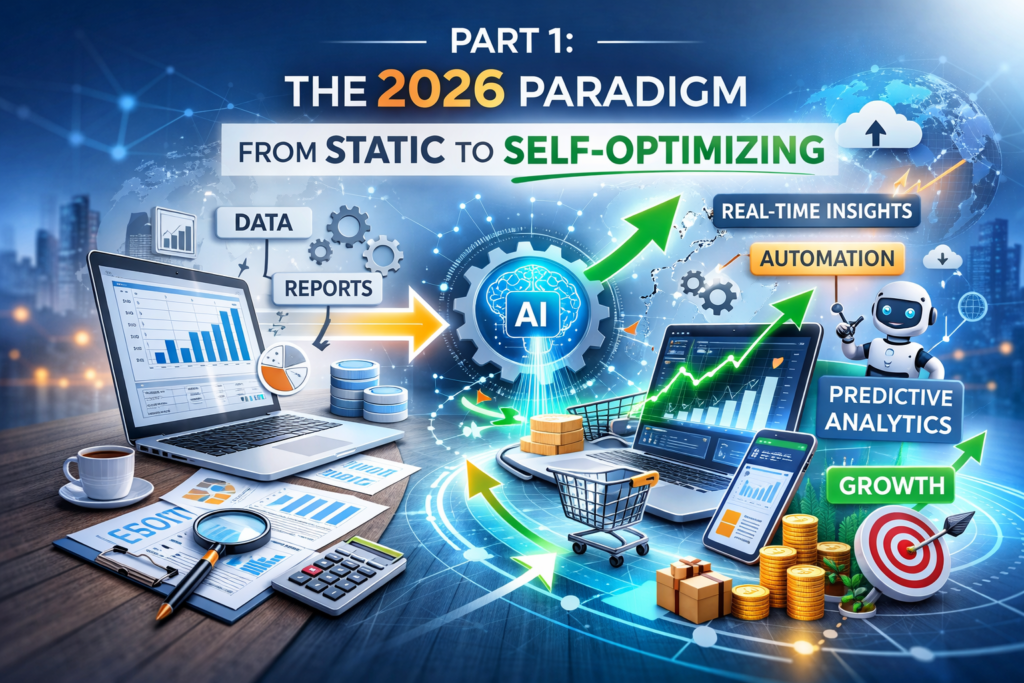
Part 1: The 2026 Paradigm – From Static to Self-Optimizing
The Limitations of Traditional CRO
Traditional conversion rate optimization suffered from three fatal flaws. First, it was slow—running statistically valid A/B tests required weeks or months of traffic, meaning optimizations lagged market realities by unacceptable margins. Second, it was static—once a test concluded and a “winner” was implemented, the site returned to stasis until the next manual experiment. Third, it was averaged—optimizations were applied to all visitors equally, ignoring the reality that different customer segments respond to different experiences .
The Agentic Optimization Breakthrough
The 2026 breakthrough is agentic optimization: systems that do not merely analyze data but autonomously execute changes based on continuous learning. Runner AI, built by a core team of former Google DeepMind engineers, exemplifies this new architecture. Its engine constantly analyzes every click and scroll, automatically initiating tests on content, layouts, and checkout flows—operating 24/7 to improve conversion rates without human intervention. Critically, it goes beyond simple A/B testing by dynamically customizing the user journey based on each visitor’s specific campaign, traffic source, or profile .
This represents a categorical shift. The storefront is no longer a static artifact but a living experiment that evolves in real time.
The Democratization Effect
For decades, the barrier to building a competitive online store was prohibitively high. Merchants were forced to hire expensive agencies for design and development or struggle through complex DIY builders requiring significant technical upkeep . Runner AI dismantles this barrier by combining conversational storefront generation with a self-optimizing backend. Users can launch a conversion-ready store simply by chatting with AI, which translates natural language prompts into complete technical operations—handling design, checkout logic, and inventory systems without writing a single line of code .
The result is the democratization of enterprise-grade growth tools. Small businesses can now access optimization capabilities previously reserved for brands with data science teams.
Part 2: The Self-Optimizing Engine – Tools That Continuously Improve
Runner AI: The Autonomous CRO Platform
Runner AI, launched in January 2026, represents the industry’s first AI-native ecommerce engine designed to autonomously test, learn, and optimize conversion rates . Its architecture delivers three core advantages over traditional builders:
Autonomous Conversion Optimization: The engine continuously analyzes every user interaction, automatically initiating tests on content, layouts, and checkout flows. It operates 24/7, identifying friction points in the user journey and deploying solutions instantly. Because it customizes experiences based on visitor source and profile, optimizations are segment-specific rather than one-size-fits-all.
From Prompts to Full-Stack Store: Users can launch a conversion-ready storefront and backend just by chatting with AI. The platform translates natural language into complete technical operations, allowing anyone to launch a sophisticated business without coding.
App-Free Feature Activation: Store owners can empower their business with any ecommerce feature—reviews, pop-ups, upsells, SEO optimization—simply by asking. Instead of installing and managing disparate plugins, users request capabilities via chat, and the platform instantly integrates them into the native infrastructure .
For merchants tired of the “app tax” and plugin management overhead, this represents a fundamentally simpler operating model.
Product Genius: Large Interaction Models for Revenue Lift
Product Genius AI, which emerged from $35 million of DARPA research and development, has introduced Large Interaction Models (LIMs)—a breakthrough that improves upon traditional Large Language Models by learning continuously in minutes rather than months .
How LIMs Work:
Applied to commerce, LIMs optimize for each shopper as they scroll and click, rapidly adapting across billions of interactions. The rapid learning takes changes in stride—shifts in shopper interests, products, ads, and markets—to create durable revenue lift. Because the AI learns while a shopper scrolls, it works without massive user data reserves, making it accessible to ecommerce businesses of any size .
Documented Results:
Controlled A/B tests involving millions of US online shoppers across 25 brands (including Betsey Johnson, a subsidiary of Steve Madden) demonstrated a 36% average revenue lift compared to the brands’ existing websites . Jeff King, Founder of Club Furniture, reports: “Product Genius is truly revolutionary! We’ve been using this app for over six months and the results have been amazing. This app allows us to offer an ‘Amazon-level’ AI driven shopping experience on a small business budget. Our time on site and add-to-carts are way up as is our revenue.”
The consumer experience is notably different: shoppers see a TikTok-like feed where the AI curates true, useful product and brand information. As they scroll, the AI can tell shoppers what it thinks their interests are so far, and shoppers can also directly tell the AI what they’d like .
OptiMonk AI: Automated CRO at Scale
OptiMonk AI has positioned itself as an AI-powered CRO platform designed to automate processes like A/B testing and personalization . Its key features directly address the manual bottlenecks that have historically limited optimization efforts:
Smart Personalizer: Personalizes landing pages for each visitor automatically, tailoring headlines, descriptions, and text based on visitor interests. This ensures landing page messaging perfectly aligns with traffic source—if a visitor arrives from a Google Ads campaign about a specific product category, the landing page messaging automatically reflects that interest.
Smart A/B Testing: Simplifies what has traditionally been a complex, time-consuming process. Marketers can seamlessly run multiple A/B tests in parallel on any section of their website. The marketer decides what to test; the AI executes them automatically.
Smart Product Page Optimizer: Leverages AI to turn product detail pages into high-converting sales pages with AI-powered copy. It can craft better headlines, descriptions, and benefit lists—and conduct A/B tests to tailor the ideal product page across thousands of SKUs concurrently .
For marketing teams that understand the importance of testing but lack the resources to execute it properly, OptiMonk AI provides an accessible path to data-driven optimization.
Part 3: The Discovery and Personalization Layer – Helping Customers Find What They Want
Constructor: AI-Powered Search and Discovery
For stores with large catalogs, search relevance is the single most important conversion factor. Constructor provides AI-powered ecommerce search and discovery using behavioral data to optimize relevance . Unlike keyword-based search that returns the same results for all users, Constructor learns from click patterns, purchase history, and browsing behavior to surface products most likely to convert for each individual shopper.
The platform is typically used by teams with large catalogs and complex inventories where standard search would otherwise bury relevant products beneath irrelevant results. Merchants report significant improvements in both conversion rate and average order value when shoppers can actually find what they’re looking for.
Bloomreach: Enterprise Personalization
Bloomreach combines AI-driven product discovery with content and merchandising personalization . For enterprise ecommerce teams, it provides the capability to tailor every aspect of the shopping experience—from search results to category pages to product recommendations—based on individual user behavior and segment characteristics.
Nosto: Real-Time Product Suggestions
Nosto helps ecommerce businesses deliver tailored shopping experiences across the entire customer journey . Its real-time product suggestions, category merchandising optimization, and audience segmentation tools enable brands to increase engagement, conversions, and average order value. The platform optimizes each touchpoint based on real-time data, ensuring that recommendations remain relevant even as customer behavior changes during a single session .
Tolstoy: Interactive Video Discovery
For visually driven categories, Tolstoy focuses on interactive video and guided shopping experiences . Using AI to personalize discovery, it transforms how shoppers interact with products—particularly valuable for fashion, home goods, and lifestyle brands where static images fail to convey the full product experience.
Evertune: Generative Engine Optimization
A new category has emerged in 2026: Generative Engine Optimization (GEO) . As consumers increasingly use AI models (ChatGPT, Perplexity, Claude) for product research, brands must ensure their products are discoverable within AI-generated answers. Evertune provides shopping intelligence to track how AI models recommend products, translating raw data into actionable optimization strategies .
Key capabilities include tracking shopping trigger rates to benchmark category purchase intent, monitoring shopping visibility to measure competitive performance, identifying which partnerships drive discovery, and seeing the price ranges AI displays for your products versus competitors .
For forward-thinking brands, GEO is rapidly becoming as important as traditional SEO.
Part 4: The Customer Engagement Layer – Conversion Through Conversation
Fin: The Resolution-First AI Agent
Fin is an AI agent designed to resolve ecommerce customer issues end to end . Unlike basic chatbots that deflect conversations, Fin uses help center content, historical conversations, and live system data to answer questions and take action. When connected to backend systems, it can execute tasks such as issuing refunds or updating accounts—reducing cost per resolution while maintaining consistent customer experience.
For ecommerce teams, the distinction between “support” and “conversion” increasingly blurs. A customer who receives instant, accurate answers to pre-purchase questions is far more likely to complete a transaction. Fin addresses both needs within a single interface.
Crescendo: Multimodal Shopping Assistant
Crescendo launched its multimodal AI shopping assistant on the Shopify App Store in January 2026 . The platform unifies service and shopping into a single experience, answering service questions and guiding shoppers toward purchase. “Multimodal” means the assistant can process and respond to both text and images—a customer can upload a photo of a desired item, and the assistant can find matching products in the catalog.
Tidio: Accessible AI Chat for SMBs
Tidio remains the default recommendation for small and mid-sized ecommerce businesses seeking AI-powered chat . Its AI chatbot answers FAQs, tracks orders, and assists customers in real time, while the live chat widget provides seamless escalation to human agents when needed. With multichannel support (Messenger, Instagram, email) and built-in lead generation tools, Tidio delivers a complete customer communication suite at accessible price points. The free basic plan with live chat makes it particularly attractive for stores just beginning their AI journey .
Knowband’s AI Chatbot for PrestaShop and OpenCart
For merchants on PrestaShop and OpenCart, Knowband released an AI chatbot in January 2026 supporting real-time conversations and providing product details, order status, shipping updates, and order tracking . The chatbot works with multiple AI models, including ChatGPT, Gemini, DeepSeek, and Claude, giving merchants flexibility in choosing their underlying technology.
Shopper Concierge and Contextual Search Agents
Tredence’s January 2026 launch of five agentic commerce accelerators includes two directly relevant to customer engagement :
Shopper Concierge Agent provides a generative AI shopping assistant that delivers relevant insights and product recommendations based on natural language conversation. Contextual Search Agent implements question-driven and contextual search, allowing customers to find products through natural language queries rather than keyword matching.
Part 5: The Content and Creative Layer – Visuals That Convert
MyEdit: All-in-One Visual Optimization
MyEdit has emerged as a powerful AI tool for ecommerce visual content, offering capabilities specifically tuned to merchant needs . Its key features address the most time-consuming aspects of product photography:
AI Background Removal: Instantly places products in any setting, season, or holiday theme with one-click background removal. Manual refinement tools allow precise adjustments when needed.
AI Magic Design: Creates eye-catching banners that attract customers without requiring design expertise.
Image Enhancement and Upscaling: Transforms phone snapshots into professional-grade visuals, ensuring product images look their best across all devices and platforms .
For ecommerce sellers, the ability to create high-quality product images quickly and affordably directly impacts conversion rates. MyEdit’s Pro Plan at just $4/month makes these capabilities accessible to even the smallest operations .
Canva AI: Integrated Design and Copy
Canva AI (Magic Write) combines AI text generation with visual design capabilities, allowing merchants to create product copy, headlines, social media captions, and matching visuals within a single workflow . The free version with limited AI uses provides an entry point; paid plans at $14.99/month unlock full access. For stores that regularly produce social content alongside product listings, this integration saves significant time.
Flair.ai and Photoroom: Specialized Product Imagery
Flair.ai generates AI-based product photography and lifestyle imagery, particularly valuable for direct-to-consumer brands seeking to reduce creative production costs . Photoroom focuses specifically on AI-powered image editing and background removal, optimized for ecommerce listings and marketplaces . Both tools address the same fundamental challenge: creating professional product visuals without professional photography budgets.
Part 6: The Content Generation Layer – Copy at Scale
Jasper: Brand-Controlled Copy Generation
Jasper remains the leading AI writing platform for ecommerce product descriptions, ads, and marketing content . Its key differentiator is brand voice customization—the ability to train the AI on your company’s writing style, ensuring generated copy sounds like your brand rather than generic AI output.
For stores with large catalogs, Jasper’s ability to generate dozens or hundreds of product descriptions in minutes transforms the economics of content creation. However, human review and brand governance remain essential; Jasper augments human writers rather than replacing them .
Pricing starts at approximately $49 per month for individual users, with team plans scaling accordingly .
Japer AI: Mobile Content Creation
For merchants who manage operations from mobile devices, Japer AI provides an iOS app optimized for quick content creation . With a 4.8/5 App Store rating, it supports writing emails, captions, blog ideas, ad copy, and product descriptions in seconds. Integration with Shopify and WooCommerce allows seamless connection to store platforms. Free basic plan available; Premium at $9.99/month or $39.99/year .
ChatGPT: The Versatile Assistant
ChatGPT remains a versatile tool for ecommerce sellers, supporting product research prompts, AI-assisted email automation, and quick content generation across multiple platforms . The free version with GPT-3.5 provides substantial capability; ChatGPT Plus at $19.99/month unlocks GPT-4 access. For brainstorming product ideas, drafting customer responses, or generating social content, ChatGPT serves as a 24/7 creative assistant.
Lyxity: Content Integration Across CMS Platforms
Lyxity launched its API in January 2026, extending its AI to WordPress, Wix, Drupal, and Strapi-powered websites . The platform enables direct connection to a website’s CMS, retrieval of performance data from Google Search Console, production of publication-ready content, review and enhancement of existing legacy content, and expansion/organization of content for improved clarity. For stores with complex content needs across multiple platforms, this integration capability is particularly valuable.
Part 7: The Post-Purchase and Intelligence Layer – Optimization Beyond the Transaction
PinchAI: Return Fraud Prevention
PinchAI, which raised $5 million in January 2026, addresses a costly problem for retailers: return fraud . Its post-purchase intelligence platform helps retailers reward loyal customers while preventing abuse. The funding will accelerate product development across abuse prediction models, warehouse intelligence systems, and an adaptive return engine.
For ecommerce businesses, reducing return fraud directly impacts profitability. PinchAI’s AI models identify suspicious patterns before losses occur, protecting margins without penalizing legitimate customers.
ConverSight and Katana: Inventory Intelligence
ConverSight partnered with Katana Cloud Inventory to deliver AI foresight to manufacturing, ecommerce, wholesale, and retail companies . The collaboration enables proactive forecasting and inventory optimization, helping merchants plan inventory, anticipate demand shifts, and reduce carrying costs. QuickStart AI for Katana transforms operational data into actionable intelligence without requiring data science expertise.
FullStory: Behavioral Analytics
FullStory provides digital experience analytics with AI-assisted insights . Session replay and behavioral analysis help merchants diagnose UX and conversion issues by showing exactly how users interact with their sites. The AI layer surfaces patterns and friction points that would otherwise require manual analysis of thousands of sessions.
Triple Whale and Polar Analytics: Ecommerce Attribution
Triple Whale offers AI-powered ecommerce analytics and attribution, helping direct-to-consumer brands understand customer lifetime value, customer acquisition cost, and marketing efficiency . Polar Analytics centralizes ecommerce performance data into AI-assisted dashboards, consolidating reporting across tools. For data-driven merchants, these platforms provide the intelligence needed to allocate marketing spend effectively.
Tredence’s Agentic Commerce Accelerators
Tredence’s January 2026 launch includes five agentic commerce accelerators with analytics applications :
Cosmos Customer Intelligence Agent predicts customer actions and models shopper preferences for real-time personalization. Customer Engagement Agent orchestrates cross-channel messaging based on behavioral signals. For merchants seeking to move beyond basic segmentation to true predictive personalization, these agents provide enterprise-grade capability.
Part 8: The Implementation Discipline – From Tools to System
The Integration Imperative
The single greatest cause of failed ecommerce optimization initiatives is not selecting the wrong tools; it is failing to connect them correctly. Fragmented data, redundant workflows, and manual transfer between systems erode the productivity gains that AI tools are purchased to deliver.
Fin.ai‘s analysis of the 2026 landscape emphasizes that the most capable AI tools can access order and payment data, customer profiles and history, and inventory and policy logic in real time . Real-time data access often matters more than model sophistication. When evaluating tools, merchants should verify integration depth with their ecommerce platform (Shopify, WooCommerce, BigCommerce, Magento) before committing.
The Consolidation Trend
Most ecommerce teams begin by adopting individual AI tools for isolated problems. Over time, fragmentation increases operational overhead and limits impact. The emerging pattern is consolidation toward fewer, more capable AI systems that can reason across customer context, execute multi-step workflows, and improve continuously with human oversight . This mirrors how ecommerce platforms evolved from plugins to platforms over the past decade.
A 90-Day Implementation Framework
Phase 1 (Days 1-30): Audit and Foundation
- Audit current tool stack. Cancel redundant subscriptions.
- Identify the single biggest conversion friction point (search, support, product imagery, checkout flow).
- Select one tool addressing that specific friction.
- Verify integration with your ecommerce platform.
Phase 2 (Days 31-60): Pilot and Validation
- Deploy to a limited segment (e.g., 10% of traffic).
- Establish baseline metrics (conversion rate, average order value, support resolution time).
- Measure actual improvement against baseline.
- Collect qualitative feedback from customers and support team.
Phase 3 (Days 61-90): Scale and Optimize
- If pilot demonstrates clear ROI, expand to full deployment.
- Document lessons learned and refine configurations.
- Begin evaluating next priority area.
- Establish ongoing monitoring cadence.
The Human-in-the-Loop Imperative
No AI can fully run an ecommerce store. Humans remain responsible for strategy, policy definition, and continuous optimization . The most successful merchants treat AI not as a replacement but as an augmentation—handling the repetitive, data-intensive work while humans focus on brand building, customer relationships, and strategic direction.
Part 9: The Selection Matrix – Matching Tool to Store Reality
Scenario A: The Micro-Store and Solopreneur (0-100 orders/month)
Primary Constraint: Budget
Secondary Constraint: Technical expertise
Recommended Starting Stack:
- MyEdit (free/$4) for product imagery
- Tidio (free basic plan) for customer chat
- ChatGPT (free) for content brainstorming
- Canva AI (free limited uses) for social visuals
Rationale: At minimal revenue, paying for sophisticated infrastructure is premature. These tools address the most common friction points—poor visuals, unanswered questions, weak copy—at zero or low cost.
Scenario B: The Growing Store (100-1,000 orders/month)
Primary Constraint: Time
Secondary Constraint: Conversion optimization
Recommended Stack:
- Product Genius or OptiMonk AI for autonomous optimization
- Jasper ($49/month) for content at scale
- Tidio ($29/month) for advanced chat features
- Flair.ai or Photoroom for product imagery
Rationale: At this stage, manual optimization becomes unsustainable. Autonomous CRO tools deliver documented 36% lifts without requiring technical expertise. Content volume increases; Jasper keeps pace.
Scenario C: The Scaling Merchant (1,000-10,000 orders/month)
Primary Constraint: Search relevance and personalization
Secondary Constraint: Operational efficiency
Recommended Stack:
- Constructor or Bloomreach for AI-powered discovery
- Fin for autonomous customer support resolution
- Klaviyo for email lifecycle automation
- FullStory for behavioral analytics
Rationale: With catalog growth, standard search fails. Dedicated discovery tools ensure customers find products. Support volume requires autonomous resolution, not just deflection.
Scenario D: The Enterprise Store (10,000+ orders/month)
Primary Constraint: Scale and complexity
Secondary Constraint: Cross-channel coordination
Recommended Stack:
- Runner AI for self-optimizing storefront
- Bloomreach or Constructor for enterprise discovery
- PinchAI for return fraud prevention
- Tredence agent suite for predictive intelligence
- Evertune for Generative Engine Optimization
Rationale: Enterprise stores require systems that orchestrate across channels and continuously optimize without human intervention. GEO becomes essential as AI-driven discovery grows.
Part 10: The Future Trajectory – From Optimization to Autonomy
The Agentic Commerce Horizon
The truly disruptive impact of AI in ecommerce will be the transition from optimization to autonomy. Tredence’s January 2026 launch of five agentic commerce accelerators signals where the industry is heading: agents that predict customer actions, generate personalized content, implement contextual search, provide concierge assistance, and orchestrate cross-channel messaging .
The Strategic Imperative
For merchants, this trajectory carries an urgent implication: the stores that win in the next three years will be those that treat AI not as a tool for incremental improvement but as the core architecture of their business.
They will recognize that static storefronts are obsolete. The new standard is a living, self-improving store that tests and optimizes continuously, personalizes experiences for each visitor, and resolves customer issues end-to-end without human intervention.
They will understand that the gap between “running a website” and “owning a self-improving business” is closing —and that the merchants on the right side of that gap will capture disproportionate share of traffic, conversion, and revenue.
Conclusion: AI tools for online store optimization
The 2026 AI tools for online store optimization landscape is no longer a collection of interesting experiments. It is a mature, structured market with clear categories, proven ROI, and accelerating adoption across every store size.
The distinction that separates successful from struggling merchants is no longer “Do we use AI for optimization?” It is “Have we architected our store operations around autonomous principles?”
Successful merchants do not ask “Which optimization tool should I buy?” They ask “Which workflows, if redesigned around autonomous agent capabilities, would deliver the greatest value in conversion lift, cost reduction, and customer satisfaction?”
They do not ask “How do I get my team to use this software?” They ask “How do I retrain my team from tactical executors to strategic supervisors of autonomous systems?”
They do not ask “Is this platform secure?” They ask “Does this platform provide the real-time data access, integration depth, and governance controls we need to trust autonomous optimization?”
The platforms profiled in this guide—Runner AI for self-optimizing storefronts, Product Genius for Large Interaction Models, Constructor and Bloomreach for discovery, Fin and Tidio for engagement, MyEdit and Jasper for content—represent the current state of the art.
But the art is advancing rapidly. The merchants that win in the next five years will be those that recognize AI optimization is not a technology replacement project. It is a business model transformation project. It requires rethinking not just how products are displayed, but how value is communicated, how customers are served, and how revenue is generated.
The tools are ready. The integration pathways are mapped. The ROI data is unambiguous. The only remaining variable is whether you will build this optimization architecture with strategic intention—or continue managing a static storefront while your competitors own self-improving businesses.

1 thought on “AI tools for online store optimization”