AI accounting software for small businesses : For decades, small business accounting software followed a predictable trajectory. You purchased a license, connected your bank accounts, and spent countless hours manually categorizing transactions, reconciling accounts, and chasing receipts. The software automated the format of financial records but not the work of creating them. You remained the operator; the software remained the tool.
By early 2026, this model has been permanently disrupted. We have entered the era of autonomous accounting—systems that do not merely record financial transactions but execute the entire accounting workflow from transaction capture through reconciliation to strategic advisory, with zero human intervention .
This transformation is visible in the numbers and the product launches. Xero now serves 4.6 million subscribers and has integrated Syft’s AI-powered analytics directly into its platform . Pilot has unveiled the world’s first fully autonomous AI Accountant, capable of onboarding businesses, configuring accounting systems, closing books, and producing complete financial statements without human involvement . Minerva, a Y Combinator-backed startup, promises to “replace all bookkeeping, accounting and tax filing jobs within small businesses globally” .
For small business owners, this shift presents an unprecedented opportunity. The time spent on manual data entry, receipt chasing, and month-end reconciliation can be reclaimed. The anxiety of “are my books accurate?” can be replaced with real-time, audit-ready confidence. The cost of professional-grade financial operations can drop from thousands per month to hundreds .
This guide provides a strategic architecture for selecting and implementing AI accounting software in 2026. It is organized not by vendor popularity but by functional capability: from embedded analytics in existing platforms to fully autonomous accounting agents, from cash flow intelligence to tax preparation automation. Each section identifies category leaders, quantifies documented impact, and provides implementation criteria calibrated to business size and maturity.
Read More : AI tools for customer data analysis
AI based project management tools for teams
AI tools for HR and employee management
AI tools for sales funnel automation
AI video maker for Facebook ads
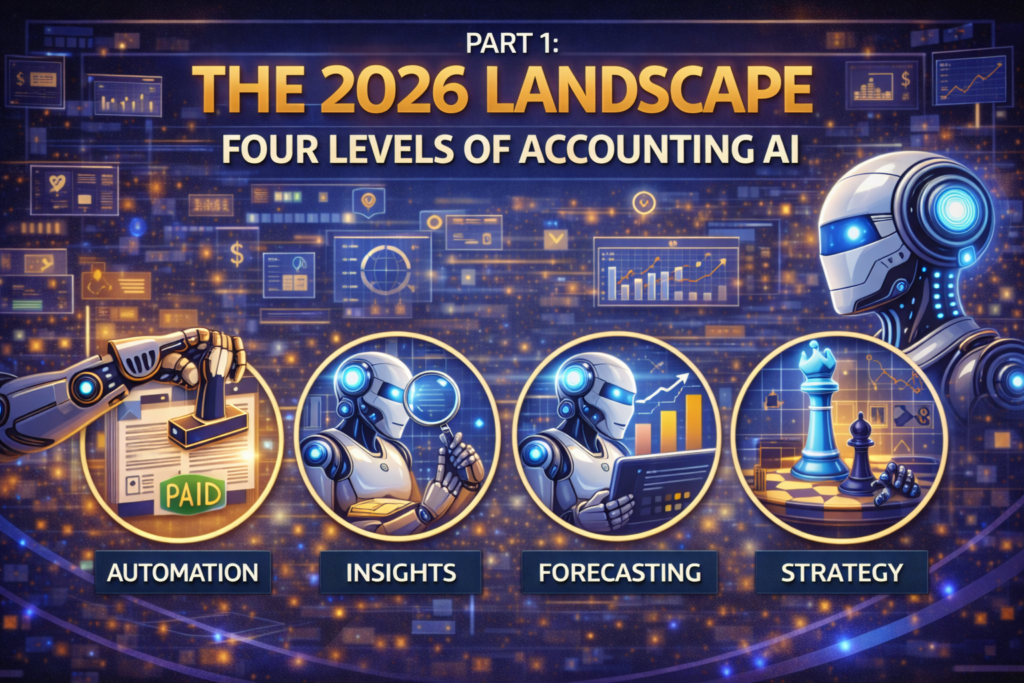
Part 1: The 2026 Landscape – Four Levels of Accounting AI
Before examining specific tools, it is essential to understand the maturity levels of AI accounting software in 2026. Not all AI is created equal, and the distinctions between levels determine which tools are appropriate for which businesses.
Level 1: AI-Enhanced Analytics
These are traditional accounting platforms with AI features layered on top. The core accounting engine remains manual—transactions still require categorization, reconciliations still need human review—but AI provides insights, summaries, and predictions based on the data entered.
Example: Xero’s new analytics suite, which provides AI-generated explanations of financial data, business health scorecards, and 180-day cash flow projections with scenario planning .
Best for: Businesses satisfied with their current accounting workflow but wanting better visibility and insights.
Level 2: AI-Powered Automation
These platforms automate specific accounting tasks—transaction categorization, receipt matching, invoice processing—but still require human oversight and periodic intervention. The AI handles the routine; the human handles exceptions and strategy.
Example: Sage Intacct’s AI-powered AP automation with line-level matching, cash intelligence dashboards, and close analytics that identify which entities are slowing down the month-end close .
Best for: Growing businesses that have outgrown manual processes but aren’t ready for full autonomy.
Level 3: Autonomous Accounting Agents
These systems execute the complete accounting workflow from end to end. They onboard new clients, configure chart of accounts, categorize transactions, reconcile accounts, handle edge cases, and produce complete, audit-ready financial statements—all without human intervention.
Example: Pilot’s AI Accountant, which “autonomously performs the full scope of bookkeeping and financial reporting end-to-end” . Minerva’s AI accountant, which “ingests everything, writes the follow-ups, answers instantly, autopilots your P&L, looks forward, turns regulations into refunds, and optimizes cash” .
Best for: Businesses ready to eliminate manual bookkeeping entirely and trust autonomous systems with their financial operations.
Level 4: Conversational Financial Intelligence
These are specialized agents that operate within specific financial workflows—accounts payable, vendor management, cash flow analysis—providing instant answers and executing tasks based on natural language queries.
Example: Melio’s Agent Mel, which answers questions like “What’s the status of the last payment made to this vendor?” or “How do I set up a vendor?” and provides immediate visibility into payment operations .
Best for: Businesses with complex payment workflows or those needing instant access to financial data without navigating multiple systems.
Part 2: The Established Platforms – AI Enhancements to Familiar Tools
Xero: Embedded Analytics at Scale
Xero’s January 2026 rollout of AI-powered analytics features across its platform represents the most significant upgrade to a mainstream small business accounting tool this year . With 4.6 million subscribers and 20% year-over-year revenue growth, Xero’s moves signal where the entire category is heading .
What’s New:
- AI-generated insights and summaries: Explanations of financial data that help business owners understand what the numbers mean, not just what they are .
- Customizable dashboards: Track performance across revenue, expenses, and KPIs with visualizations such as graphs and tables .
- 180-day cash flow manager: Projections with scenario planning for “what if” outcomes .
- Business health scorecards: Custom metrics that can incorporate external data such as website traffic alongside financial information .
- Syft integration: The analytics platform Xero acquired in 2024 is now embedded directly, providing actionable insights to millions of customers .
The Strategic Direction:
Xero is positioning these tools around business owners rather than specialist analysts, making sophisticated financial analysis accessible to non-experts . The company also recently unveiled JAX, an AI financial “superagent” that learns how a business runs, automates routine tasks, and orchestrates multiple AI agents to cut workloads . This signals Xero’s long-term trajectory toward autonomous accounting.
Implementation Consideration:
For existing Xero users, these features are being rolled out directly within the platform. No migration or additional purchase is required for access to the enhanced analytics capabilities.
Sage Intacct: High-Performance Finance for Growing Businesses
Sage has been aggressively expanding its AI capabilities across both its Intacct and X3 platforms. The February 2026 R1 release for Sage Intacct introduces a comprehensive suite of AI-powered features designed to help finance teams “move from managing data to driving performance” .
What’s New in Sage Intacct R1 2026:
- Finance Intelligence Agent: Allows finance teams to ask natural language questions and receive instant, actionable answers that combine data, analysis, and recommendations. It works alongside existing Close, AP, Time, and Assurance Agents .
- Close Analytics: AI-powered insight into close performance through interactive charts, historical trends, and bottleneck detection. Teams can track days-to-close across entities and periods, identifying recurring handoff issues .
- Cash Intelligence: Single-screen view of short-term cash position, expected requirements, and forecasted changes. AI-driven insights help identify potential shortfalls and prioritize payments .
- AP Automation with AI Line-Level Matching: Matches invoice lines directly to purchase order lines and flags discrepancies earlier in the process .
- AI-Powered Import Agent: Simplifies complex data imports using natural language transformations and flexible mapping, eliminating the need for external tools or manual manipulation .
- Sage Intacct Data Cloud: Provides governed, direct access to Intacct data in Snowflake with zero ETL and no data duplication, enabling advanced analytics and AI use cases .
Implementation Consideration:
Sage Intacct is positioned for mid-sized, growing businesses with more complex financial operations than micro-businesses. The new features are being rolled out to Early Adopters in phases, with global availability following.
FreshBooks + Kick: Self-Driving Bookkeeping for Service Businesses
FreshBooks, long favored by service-based small businesses for its simplicity, has partnered with Kick—a bookkeeping platform backed by OpenAI, Google Ventures, and General Catalyst—to offer “self-driving bookkeeping” to U.S. customers .
What the Partnership Delivers:
- Automated categorization and reconciliation: Kick automatically processes transactions, receipts, and documents, keeping financial data current and tax-ready .
- Human bookkeeper review: Unlike fully autonomous systems, Kick includes a human review layer, combining AI efficiency with professional oversight .
- Focus on compliance: Designed to help businesses stay organized as tax pressures intensify, with IRS data showing business income tax collections more than doubling since 2018 .
The Differentiator:
Kick’s approach pairs AI advancements with accounting domain experts to automate previously manual work while maintaining human accountability . This hybrid model may appeal to business owners who want automation but aren’t ready to trust fully autonomous systems.
Implementation Consideration:
Available to U.S.-based FreshBooks customers as an integrated offering. This is a partnership, not an acquisition—FreshBooks customers access Kick’s capabilities within the FreshBooks ecosystem .
Part 3: The Autonomous Agents – Accounting Without Humans
Pilot AI Accountant: The Fully Autonomous System
On February 4, 2026, Pilot announced the world’s first AI Accountant—a fully autonomous system that runs the entire bookkeeping process from onboarding to monthly close with zero human intervention .
What It Actually Does:
The Pilot AI Accountant autonomously performs the full scope of bookkeeping and financial reporting end-to-end :
- Onboarding: Configures accounting systems and closes historical books
- Transaction processing: Categorizes transactions and reconciles accounts
- Edge case handling: Applies contextual decision-making to complex or unusual cases
- Financial statement production: Delivers complete profit and loss, cash flow, and balance sheet statements
- Continuous monitoring: Analyzes financial activity to identify discrepancies, highlight meaningful changes, and surface issues
- 24/7 advisory chat: Provides real-time, actionable guidance on key business drivers and trends
The Data Advantage:
Pilot has performed high-quality bookkeeping at scale for over 7,000 startups and small businesses over the past decade . The AI Accountant applies this operational knowledge and experience, unifying industry-leading data, process, and execution in a single system.
The Value Proposition:
“With the AI Accountant, businesses can be fully onboarded and have their books closed in hours, not weeks,” said Jessica McKellar, Founder and CEO of Pilot. “Customers get accurate financials and insights much faster, without compromising on quality or cost” .
Auditability and Transparency:
Every transaction and decision is logged, providing transaction-level visibility and a full audit history—far beyond traditional monthly reports . This addresses the trust gap that has historically prevented businesses from fully automating financial operations.
Minerva: The “CFO-Grade” AI Accountant
Minerva, launched on Y Combinator in February 2026, takes an even more aggressive stance on the future of accounting. Its founders state directly: “We believe accountants will not exist in 10 years. AI has just now made it possible to automate almost every single task they do, and we are here to capitalize on that” .
What Minerva Delivers:
Minerva positions itself as a “CFO-grade, AI-powered accounting service” with capabilities extending far beyond bookkeeping :
- Seamless data capture: Instantly syncs with email, WhatsApp, Stripe, Shopify, Google Drive, and any platform where money moves
- Autonomous follow-ups: Auto-emails vendors, customers, or teammates to chase receipts, fix POs, or renegotiate terms
- Instant Q&A: Answers questions like “burn-rate trend” or “campaign ROI” with audit-ready numbers and plain-English explanations
- Autopilot P&L management: Spots gaps in real time, pings the right person, and reconciles the moment data lands
- Forward-looking forecasts: Runs live 13-week cash forecasts, Monte-Carlo stress tests, and hiring “what-if” scenarios
- Tax optimization: Tracks global tax codes, surfaces credits and deductions, prepares forms, and e-files on time
- Cash optimization: Sweeps idle balances into high-yield accounts, times payments for float and discounts
- Board deck generation: Auto-builds board decks, KPI dashboards, and investor memos with charts, insights, and even voice-overs
- Audit readiness: Maintains a time-stamped evidence vault and runs continuous mock audits
- Self-learning: Each close cycle sharpens categorization and forecasts without upgrades
The Founders’ Vision:
Peter Zhu and Om Agarwal, the founders, have “two decades of combined experience building software” and have been building together since high school . Their ambition is clear: to replace all bookkeeping, accounting, and tax filing jobs within small businesses globally.
Implementation Consideration:
Minerva is currently available for demos and early access. For businesses ready to embrace fully autonomous accounting, this represents the cutting edge of what’s possible.
Part 4: The Specialized Agents – Cash, Payments, and Tax Intelligence
Melio Agent Mel: Conversational Payment Intelligence
For businesses whose primary financial complexity lies in accounts payable and receivable, Melio’s Agent Mel offers a specialized solution . Launched in January 2026, this AI-powered assistant is fully embedded in Melio’s workflow and requires no setup.
What Agent Mel Does:
- Instant status answers: “What’s the status of the last payment made to this vendor?” “How many payments are in progress for this client?”
- Cash flow visibility: Highlights overdue payments, displays payment patterns, and shows vendor history
- Feature guidance: “How do I set up a vendor?” “How can I set up payment approval policies?”
- Vendor analysis: “Who are the top three vendors I paid last year?”
The Market Context:
Agent Mel addresses the growing demand for intelligent, automated financial assistance. Indeed, 40% of enterprise applications are predicted to be integrated with task-specific AI agents by the end of 2026 .
The Value Proposition:
“Agent Mel gives accountants and small businesses swift access to the data they need, eliminating hours of manual searching and empowering them to make smarter decisions faster,” said Matan Bar, CEO of Melio .
Implementation Consideration:
Available now to Melio users with no setup required. Particularly valuable for businesses with high payment volumes or complex vendor relationships.
DynaTax AI: Tax-Focused Bookkeeping
Texas-based DynaTax AI has rolled out an AI-powered platform specifically designed to help small business owners organize financial transactions, manage receipts and tax documents, and access plain-English tax guidance .
Key Features:
- AI-led transaction categorization: Automatically organizes financial transactions
- Smart document handling: Manages receipts and tax documents
- Mobile-friendly access: Works on devices for on-the-go business owners
- Conversational tax guidance: Provides plain-English answers to tax questions
- AI Tax Research Assistant (for practitioners): Provides instant responses to complex tax queries with references to IRS regulations and relevant tax code sections
The Founder’s Perspective:
“Small business owners don’t need more complicated software—they need clarity and confidence,” said Chau Tran, founder of DynaTax AI. “DynaTax AI acts as a financial co-pilot, helping users understand their numbers and prepare for tax season more effectively” .
Target Audience:
The platform is tailored specifically for freelancers, truck drivers, realtors, contractors, and small enterprises—segments often underserved by general-purpose accounting software.
Implementation Consideration:
Available now for U.S.-based businesses. A forthcoming Pro Firm Subscription for CPAs and tax professionals will add firm management and marketplace features in 2026.
LayerNext: The Mobile-First AI CFO
LayerNext, available as an iPhone app, positions itself as “your AI CFO and bookkeeper” with a mobile-first approach .
What It Delivers:
- Automated bookkeeping: Upload or forward any receipt, bill, or invoice; LayerNext extracts details, categorizes correctly, and syncs into QuickBooks automatically
- Automatic reconciliation: Bank and credit card transactions are matched against books in real time; duplicates, mismatches, and missing entries are flagged instantly
- Deep financial insights: See burn rate, cash flow, and runway at a glance
- Natural language Q&A: Ask questions like “What is my burn this month?” or “What expenses increased this week?” and receive clear answers based on real financial data
Target Audience:
“Whether you are running a startup, agency, or small business, LayerNext keeps your books clean without hiring a bookkeeper” .
Implementation Consideration:
Requires iOS 15.1 or later and connects directly to QuickBooks. For business owners who prefer mobile-first operations and already use QuickBooks.
Part 5: The Selection Framework – Matching Tool to Business Reality
Scenario A: The Micro-Business and Solopreneur
Primary Constraint: Budget. Secondary Constraint: Time.
Recommended Solution: DynaTax AI or LayerNext, depending on platform preference.
Rationale:
At zero to low revenue, paying for sophisticated accounting infrastructure is premature. DynaTax AI’s mobile-friendly, tax-focused approach serves freelancers and contractors well. LayerNext works for those already committed to QuickBooks and preferring mobile operations.
Budget Range: Free to $30/month.
Scenario B: The Established Small Business (Service-Based)
Primary Constraint: Simplicity. Secondary Constraint: Integration with existing tools.
Recommended Solution: FreshBooks + Kick partnership.
Rationale:
FreshBooks has long dominated service-based small business accounting for its simplicity. The Kick integration adds automated bookkeeping with human review, preserving simplicity while adding automation. The hybrid model (AI + human review) may appeal to business owners not yet ready for full autonomy.
Budget Range: $30-100/month depending on transaction volume and feature requirements.
Scenario C: The Growing Business with Complex Operations
Primary Constraint: Scalability. Secondary Constraint: Multi-entity management.
Recommended Solution: Sage Intacct.
Rationale:
For businesses with multiple entities, complex revenue streams, or international operations, Sage Intacct’s comprehensive AI capabilities—close analytics, cash intelligence, AP automation, and the Finance Intelligence Agent—provide enterprise-grade capabilities at mid-market price points. The Snowflake integration enables advanced analytics use cases.
Budget Range: Enterprise pricing; typically $500-2,000/month depending on modules and user count.
Scenario D: The Business Ready to Eliminate Manual Bookkeeping
Primary Constraint: Time. Secondary Constraint: Accuracy.
Recommended Solution: Pilot AI Accountant or Minerva.
Rationale:
For businesses ready to trust fully autonomous systems, Pilot and Minerva represent the current state of the art. Pilot’s decade of operational experience with 7,000+ clients provides a data advantage. Minerva’s more aggressive feature set (cash optimization, board deck generation, Monte-Carlo stress tests) appeals to growth-stage startups needing CFO-level intelligence.
Budget Range: Pilot pricing not publicly listed; Minerva demo-based. Expect $300-1,000/month for full-service autonomous accounting.
Scenario E: The Payment-Intensive Business
Primary Constraint: Payment workflow visibility. Secondary Constraint: Vendor management.
Recommended Solution: Melio Agent Mel integrated with Xero.
Rationale:
For businesses where accounts payable and receivable complexity dominates, Agent Mel’s conversational payment intelligence provides instant answers without navigating multiple systems. The Xero ownership connection ensures integration depth.
Budget Range: Included in Melio platform; transaction-based pricing for payments.
Part 6: The Implementation Discipline – From Adoption to Autonomy
Phase 1: Audit Your Current Workflow
Before selecting any tool, document your current financial operations:
- Time spent: How many hours weekly on data entry, reconciliation, receipt chasing?
- Pain points: Where do errors occur? What do you dread about month-end?
- Integration needs: What platforms do you use? Stripe? Shopify? PayPal? Square?
- Tax complexity: Single jurisdiction or multiple? Sales tax? International?
Phase 2: Match Tool to Readiness
Be honest about your comfort with autonomous systems:
- If you want insights but not automation: Xero’s enhanced analytics suite
- If you want automation with human oversight: FreshBooks + Kick
- If you want full autonomy: Pilot or Minerva
- If you have complex payment workflows: Melio Agent Mel
Phase 3: Pilot Before Committing
Most platforms offer demos or trial periods. Use them to validate:
- Integration accuracy: Does the system correctly interpret your specific revenue streams and expense categories?
- Exception handling: How does it handle unusual transactions or edge cases?
- User experience: Is the interface intuitive for your needs?
- Support responsiveness: How quickly do issues get resolved?
Phase 4: Establish Oversight Cadence
Even with autonomous systems, periodic review is essential:
- Weekly: Review flagged transactions and exceptions
- Monthly: Verify financial statements before relying on them for decisions
- Quarterly: Compare AI categorization against manual review sample
- Annually: Full audit readiness check before tax filing
Phase 5: Plan for Continuous Optimization
AI accounting systems improve with use. Ensure you’re capturing that value:
- Provide feedback: When categorization is wrong, correct it. The system learns.
- Review insights: Don’t just automate; use the insights for better decisions.
- Update as you grow: As your business complexity increases, your accounting stack should evolve.
Part 7: The Strategic Horizon – What Comes Next
The Agentic Accounting Future
The trajectory is clear and accelerating:
2024: AI assistants that answer questions about financial data
2025: AI copilots that suggest categorizations and flag anomalies
2026: AI agents that execute complete accounting workflows
2027+: Multi-agent systems that handle not just accounting but integrated financial operations—tax planning, cash optimization, financing decisions, strategic advisory
The Implications for Small Business Owners
For the first time in history, small business owners have access to financial operations capabilities that were previously exclusive to enterprises with dedicated finance teams:
- Real-time visibility: Not monthly reports but instant answers
- Strategic intelligence: Not historical data but forward-looking forecasts
- Autonomous execution: Not manual work but self-operating systems
- Expert-level accuracy: Not guesswork but audit-ready precision
The Implications for Accountants
Pilot’s CEO emphasizes that autonomous accounting doesn’t eliminate accountants—it elevates them: “By automating the repetitive work, we give accountants more time to focus on higher-value advisory work” .
Accountants who embrace this shift will transform from compliance-focused number-crunchers to strategic advisors, helping clients interpret insights, plan for growth, and navigate complexity. Those who resist will find themselves competing with systems that are faster, cheaper, and increasingly more accurate.
Conclusion: AI accounting software for small businesses
The 2026 AI accounting software landscape for small businesses is no longer a collection of interesting experiments. It is a mature, structured market with clear categories, proven capabilities, and accelerating adoption.
The distinction that separates successful from struggling businesses is no longer “Do we use accounting software?” It is “Have we architected our financial operations around autonomous principles?”
Successful business owners do not ask “Which accounting tool should I buy?” They ask “Which financial workflows, if redesigned around autonomous agent capabilities, would deliver the greatest value in time saved, errors eliminated, and insights generated?”
They do not ask “How do I get my bookkeeper to use this software?” They ask “How do I retrain my financial team from transaction processors to strategic advisors?”
They do not ask “Is this platform secure?” They ask “Does this platform provide the auditability, transparency, and control I need to trust autonomous financial operations?”
The platforms profiled in this guide—Xero for embedded analytics, Sage Intacct for mid-market complexity, Pilot and Minerva for full autonomy, Melio for payment intelligence, DynaTax AI for tax-focused needs, LayerNext for mobile-first operations—represent the current state of the art.
But the art is advancing rapidly. The organizations that win in the next five years will be those that recognize AI accounting is not a technology replacement project. It is an operational redesign project. It requires rethinking not just how financial data is recorded, but how financial decisions are made, how cash is optimized, how taxes are planned, and how growth is financed.
The tools are ready. The integration pathways are mapped. The ROI data is unambiguous.
The only remaining variable is whether you will build this financial architecture with strategic intention—or continue operating with manual processes while your competitors close their books in hours, optimize their cash in real time, and make decisions based on insights rather than guesses.

3 thoughts on “AI accounting software for small businesses”