AI Video Generation from Text : In the history of visual storytelling, we stand at an unprecedented threshold: the ability to transform written words directly into moving images through artificial intelligence. Text-to-video AI represents not merely another editing tool, but a fundamental reimagining of how visual narratives are conceived and created. This technology enables anyone with language—regardless of budget, technical skill, or access to equipment—to produce video content directly from their imagination. This guide explores this emerging landscape in depth, examining not just the tools available but the creative philosophies, technical foundations, and ethical considerations that will define this new era of visual communication.
Section 1: Understanding the Technology – How Words Become Moving Images
The Technical Architecture: Beyond Simple Animation
Unlike earlier video generation that merely animated static images, modern text-to-video AI operates through sophisticated diffusion models that understand temporal coherence. These systems don’t just generate frames individually; they understand how objects should move, change, and interact over time. The architecture typically involves:
- Temporal understanding: Recognizing that if a person is walking left in frame one, they should continue leftward in subsequent frames.
- Physics modeling: Implicit understanding of gravity, momentum, and object interaction.
- Semantic consistency: Maintaining character identities, environmental details, and narrative logic across time.
- Style persistence: Keeping consistent visual aesthetics throughout generated sequences.
This temporal intelligence distinguishes true video generation from merely stitching together AI-generated images.
See More : AI Chatbots For Customer Support Automation
The Training Data Universe
Current text-to-video models have been trained on millions of video-text pairs—everything from Hollywood films to YouTube tutorials, stock footage to amateur home videos. This diverse training enables remarkable flexibility but also introduces specific biases and limitations:
- Western cultural narratives often dominate unless specifically counteracted
- Common actions (walking, talking) appear more natural than rare ones
- Professional cinematography styles may override personal or experimental approaches
- Copyrighted material influences outputs even without direct copying
Understanding these foundations helps creators work with rather than against the technology’s inherent tendencies.
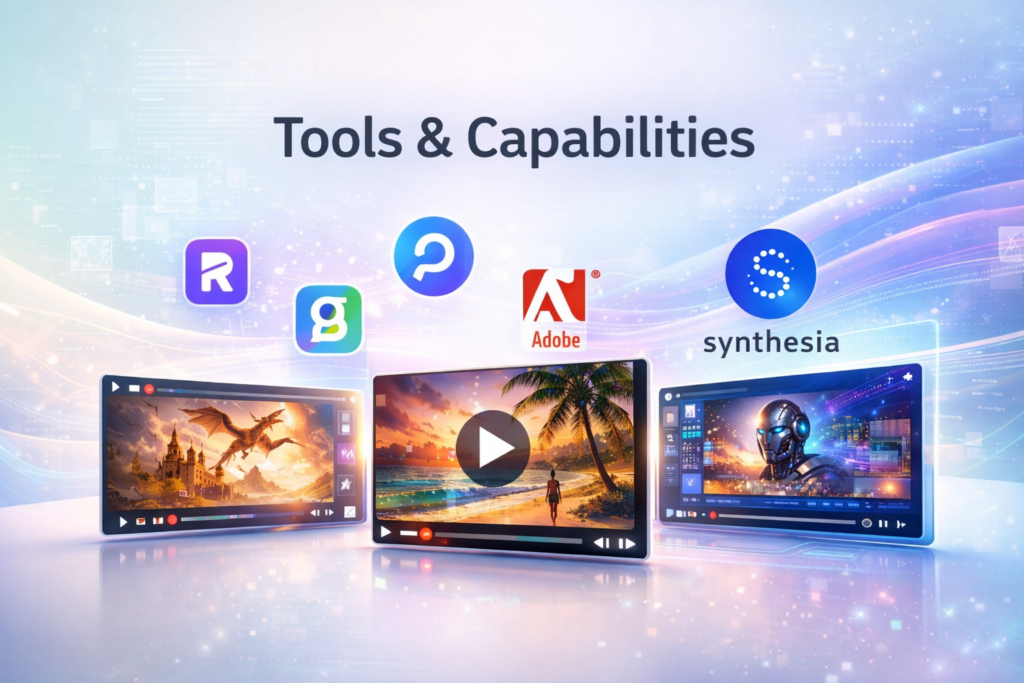
Section 2: Current Landscape – Tools and Capabilities
1. RunwayML Gen-2: The Professional’s Playground
While primarily a paid platform, Runway’s pioneering work in text-to-video deserves examination as it sets industry standards. Their approach emphasizes control through multiple input methods:
- Text-to-video: Direct generation from descriptive prompts
- Image-to-video: Animating existing still images
- Style transfer: Applying specific visual aesthetics to generated content
- Camera control: Simulating specific camera movements and angles
What distinguishes Runway is its understanding of cinematic language. Prompts like “dolly zoom revealing character’s realization” or “slow pan across dystopian cityscape at golden hour” yield videos that understand not just what to show but how to show it cinematographically.
2. Pika Labs: The Accessible Innovator
Pika’s approach emphasizes accessibility and rapid iteration. Their free tier (with limitations) and straightforward interface lower barriers significantly. Key features include:
- Aspect ratio flexibility: Square for social, widescreen for traditional, vertical for mobile
- Style consistency tools: Maintaining character or environment across generations
- Negative prompting: Explicitly excluding unwanted elements
- Community sharing: Learning from others’ successful prompts
Pika excels at short-form content—3-4 second clips perfect for social media, presentations, or quick illustrations of concepts.
3. Stability AI’s Video Diffusion: The Open-Source Contender
Stability’s open approach (available through various interfaces, some free) represents a different philosophy. Their model prioritizes:
- Customizability: Ability to fine-tune on specific datasets
- Transparency: Open weights and training approaches
- Community development: Rapid iteration through community contributions
- Local deployment: Potential to run on powerful personal machines
For creators needing specific styles (medical animations, historical recreations, specialized technical visuals), Stability’s approach allows adaptation that closed systems cannot match.
4. Luma Labs Dream Machine: The Quality Frontier
Luma’s recently released tool represents current state-of-the-art in coherence and quality. While access is limited, its capabilities reveal where the technology is heading:
- Extended duration: Up to 10-second coherent generations
- Complex motion: Multiple interacting elements with consistent physics
- Emotional expression: Character facial expressions that match described emotions
- Environmental interaction: Objects responding believably to forces and characters
Dream Machine’s outputs demonstrate that the “uncanny valley” of AI video is narrowing rapidly.
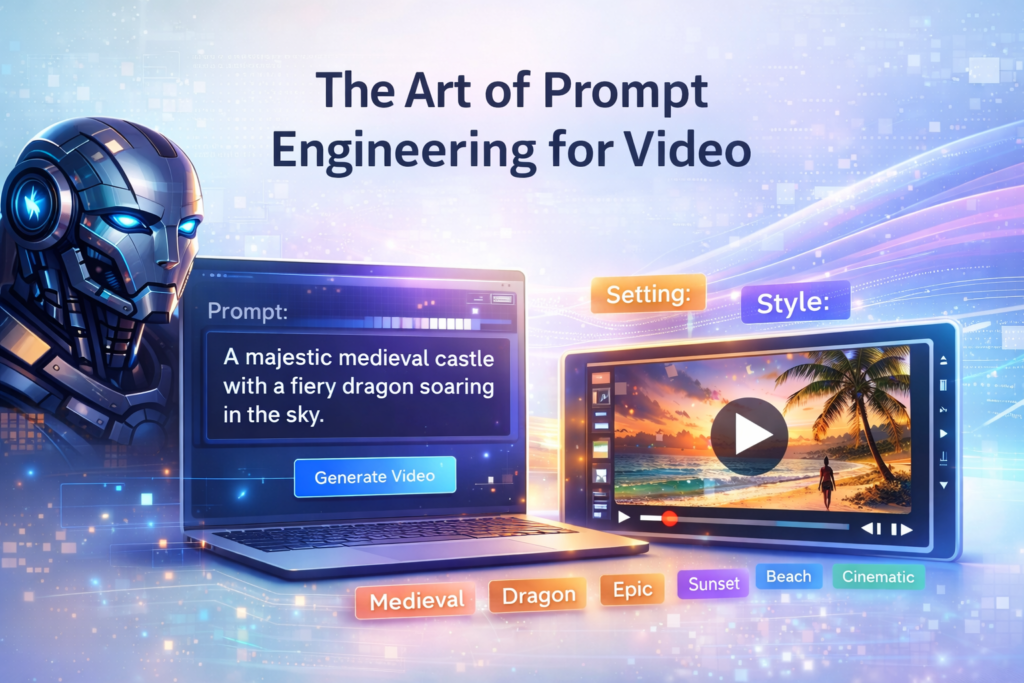
Section 3: The Art of Prompt Engineering for Video
Beyond Static Image Prompts
Video generation requires thinking in four dimensions (three spatial plus time) rather than three. Effective prompts include:
Temporal Elements:
- “Slow zoom over 5 seconds from wide shot to close-up”
- “Character enters from left, pauses, then exits right”
- “Leaves begin falling at second 2, accelerating through second 5”
- “Light transitions from dawn to midday across the sequence”
Motion Specifications:
- “Camera follows subject in smooth tracking shot”
- “Quick cut between three different angles”
- “Hand-held camera effect with slight shake”
- “Time-lapse of clouds moving rapidly”
Narrative Progression:
- “Scene begins tense, relaxes midway, becomes tense again”
- “Character’s expression transitions from confusion to understanding”
- “Object gradually transforms from old to new version”
- “Color palette shifts from cool to warm tones”
Advanced Prompt Structures:
The most successful video prompts often follow a structured format:
- Scene Setting: “A Victorian laboratory at night, raining outside window”
- Subject Description: “An elderly inventor with wild white hair”
- Action Sequence: “Tinkering with a brass device, which begins to glow”
- Camera Direction: “Close-up on hands, then slow pull back to reveal whole machine”
- Style Guidance: “Steampunk aesthetic, cinematic lighting, detailed textures”
- Technical Parameters: “4 seconds, 24fps, smooth motion, no jump cuts”
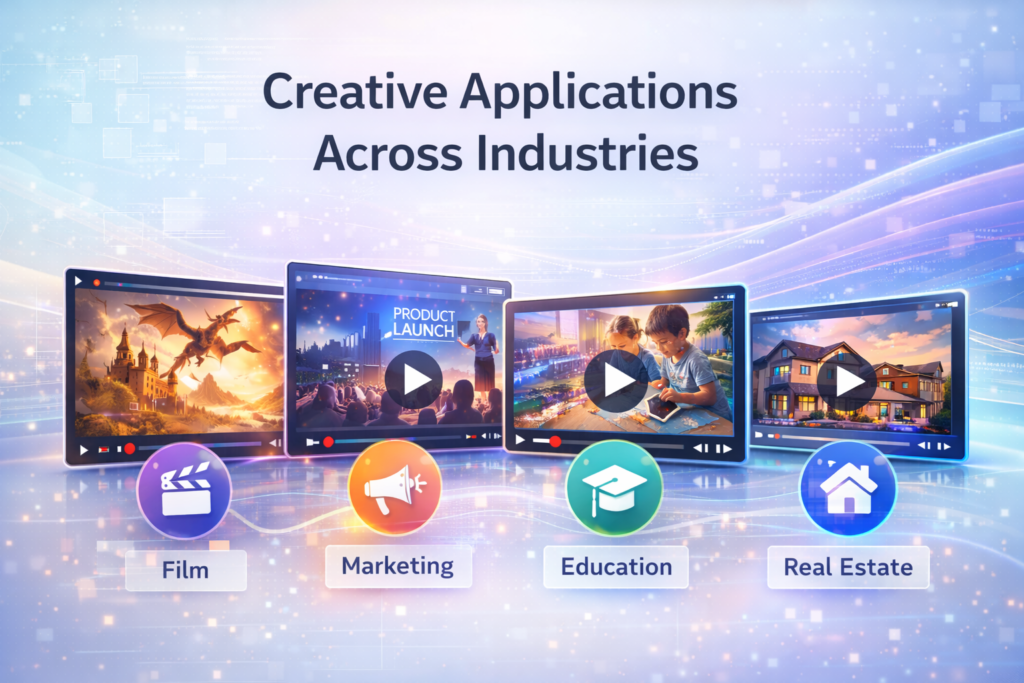
Section 4: Creative Applications Across Industries
1. Independent Filmmaking and Storyboarding
For independent creators, text-to-video revolutionizes pre-production:
- Concept visualization: Generate multiple interpretations of a scene before committing resources
- Pitch materials: Create proof-of-concept clips for funding applications
- Location scouting: Visualize how different environments might work
- Character design: Test how characters might move and express themselves
A filmmaker might generate ten versions of a crucial scene with different lighting, angles, and pacing to determine the most effective approach before shooting begins.
2. Marketing and Advertising
The advertising implications are profound:
- Rapid prototyping: Test dozens of ad concepts in hours rather than weeks
- Personalization: Generate slightly different videos for different demographic segments
- A/B testing: Create variations for different platforms and measure engagement
- Seasonal adaptation: Quickly modify existing campaigns for different holidays or events
A small business could generate social media videos tailored to morning versus evening audiences, urban versus rural demographics, or different cultural contexts.
3. Education and Training
Educational content creation becomes dramatically more accessible:
- Historical recreation: Visualize historical events described in texts
- Scientific visualization: Animate complex processes (cellular mitosis, planetary formation)
- Language learning: Create contextual videos for vocabulary acquisition
- Safety training: Simulate dangerous scenarios without actual risk
A history teacher could generate videos showing daily life in ancient Rome, a chemistry teacher could visualize molecular interactions, all from textbook descriptions.
4. Game Development and Worldbuilding
Game developers can accelerate multiple processes:
- Concept art in motion: See environments and characters animated early in design
- Cutscene prototyping: Test narrative sequences before expensive animation
- Environmental storytelling: Generate background animations that bring worlds to life
- Character animation tests: Experiment with movement styles and personalities
An indie game studio could generate hundreds of environmental variations to establish consistent visual rules for their world before any manual art begins.
5. Therapeutic and Personal Expression
Emerging applications include:
- Dream visualization: Creating videos from dream descriptions for therapy
- Memory preservation: Generating approximations of described memories
- Communication aid: Helping nonverbal individuals express experiences visually
- Art therapy: Externalizing internal states through generated imagery
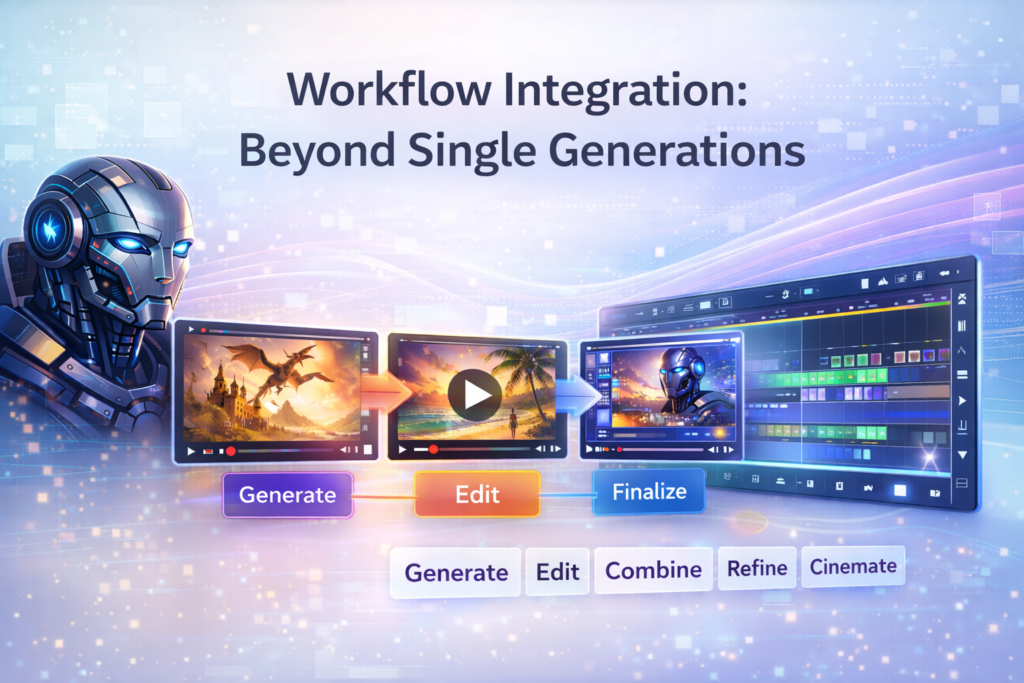
Section 5: Workflow Integration – Beyond Single Generations
The Multi-Pass Approach
Professional results rarely come from single prompts. Effective workflows involve:
Pass 1: Concept Generation
- Generate multiple short clips exploring different interpretations
- Focus on mood, style, and basic composition
- Keep prompts simple: “lonely astronaut on alien planet”
Pass 2: Refinement
- Select promising concepts and generate longer versions
- Add specific details: “lonely astronaut dragging oxygen tank through violet dust, helmet reflecting double moons”
- Experiment with camera movements and timing
Pass 3: Enhancement
- Use image-to-video to refine specific frames
- Generate additional elements separately (background, foreground, characters)
- Composite multiple generations together
Pass 4: Post-Processing
- Use traditional editing software for color grading, sound, transitions
- Add practical effects to cover AI imperfections
- Blend with live-action or traditional animation elements
The Hybrid Production Pipeline
Forward-thinking creators are developing workflows that combine AI generation with traditional techniques:
- AI-generated backgrounds with live-action foreground elements
- Traditional character animation placed in AI-generated environments
- AI-assisted storyboarding followed by practical filming
- Mixed media approaches where AI handles difficult or expensive shots
This hybrid approach leverages AI’s strengths while maintaining human creative control where it matters most.
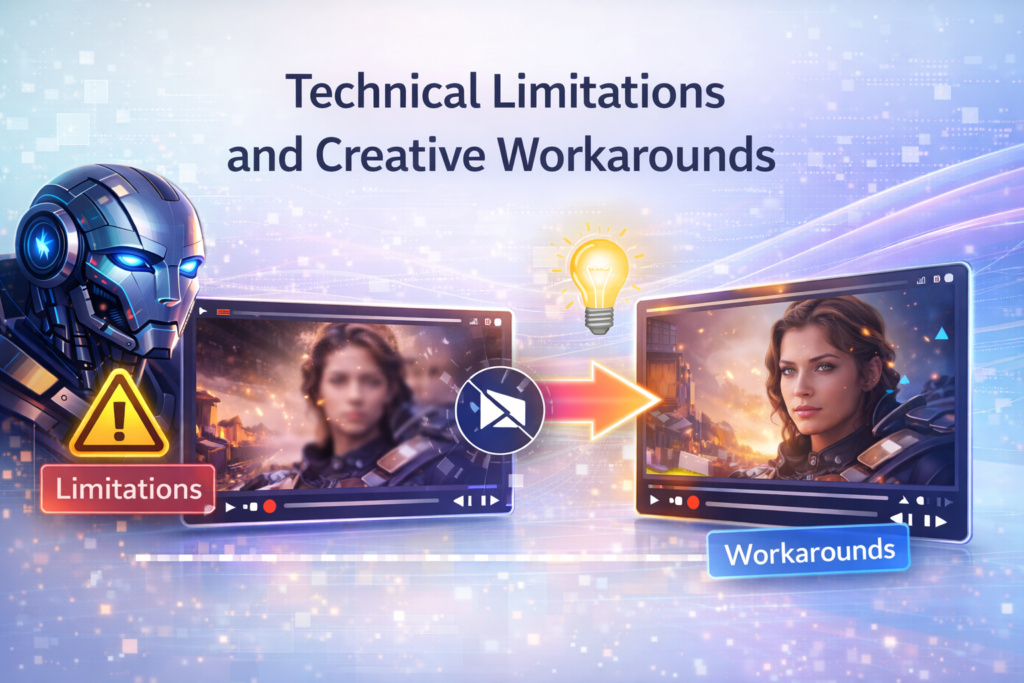
Section 6: Technical Limitations and Creative Workarounds
Current Technical Constraints
Understanding limitations is crucial for effective use:
Duration Limitations:
- Most systems max out at 4-10 seconds of coherent generation
- Workaround: Generate multiple clips and edit together with careful transitions
- Creative approach: Design for short, impactful moments rather than long narratives
Consistency Challenges:
- Characters may change appearance between shots
- Workaround: Generate characters separately and composite into scenes
- Creative approach: Use costume or setting elements to maintain identity
Physics and Logic Issues:
- Objects may defy gravity or interact unrealistically
- Workaround: Use negative prompts (“no floating objects”)
- Creative approach: Embrace surrealism or stylized reality
Resolution and Detail:
- Fine details (text, facial features) often blur or distort
- Workaround: Use higher resolution image generation for key frames
- Creative approach: Suggest detail rather than demanding photorealism
Emerging Solutions:
- ControlNet for video: Applying pose, depth, or edge guidance across frames
- Temporal attention mechanisms: Improved tracking of elements across time
- Model fine-tuning: Training on specific styles or subjects for consistency
- Multi-model approaches: Using specialized models for different elements
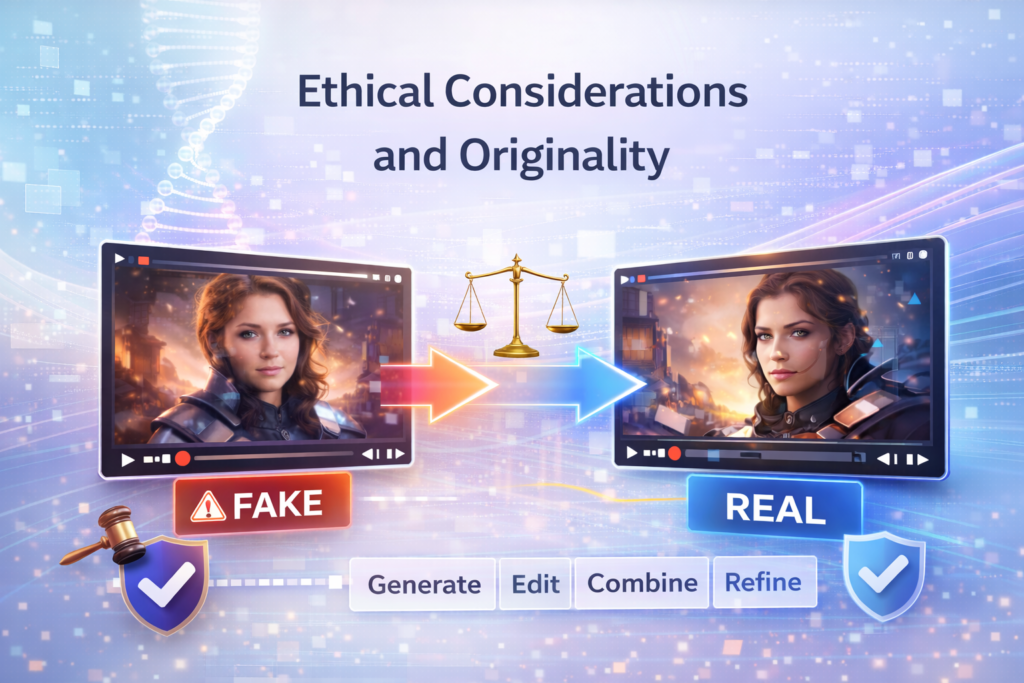
Section 7: Ethical Considerations and Originality
The Copyright Conundrum
Text-to-video AI exists in a legal gray area:
- Training data includes copyrighted material without explicit permission
- Generated videos may resemble specific films or styles closely enough to raise concerns
- Legal precedents from image generation don’t necessarily apply to video
Best practices for ethical use:
- Disclose AI generation when appropriate for context
- Avoid directly referencing copyrighted characters or specific scenes
- Use original descriptive language rather than copying existing treatments
- Consider the ethical implications of deepfake-adjacent capabilities
The Authenticity Question
As AI video becomes indistinguishable from human-created content:
- How should audiences be informed about content origins?
- What responsibilities do creators have regarding disclosure?
- How do we preserve value for human-created content?
- What constitutes “originality” in AI-assisted creation?
Developing personal ethical frameworks before these questions are legally settled positions creators as responsible early adopters rather than opportunistic exploiters.
The Representation and Bias Challenge
AI video generators inherit biases from their training data:
- Certain demographics may be over- or under-represented
- Cultural contexts may be Western-centric
- Gender roles and occupations may reflect stereotypical portrayals
- Physical abilities and body types may lack diversity
Conscious creators can counteract these biases through:
- Specific, counter-stereotypical prompting
- Using multiple models with different training data
- Manually diversifying generated content during curation
- Supporting development of more balanced training datasets
Section 8: The Business Landscape – Monetization and Commercial Use
Current Commercial Models
Different platforms offer varying approaches:
Subscription Tiers:
- Free tiers with watermarks and limitations
- Pro tiers with higher quality and commercial rights
- Enterprise solutions with custom models and support
Credit Systems:
- Purchase generation credits in batches
- Different costs for different quality levels or durations
- Often combined with subscription for base access
Open Source Approaches:
- Free to use but requiring technical expertise
- Potential for local installation avoiding ongoing costs
- Community support rather than formal customer service
Emerging Revenue Streams:
- Stock video generation: Creating custom stock footage on demand
- Personalized content: Generating videos tailored to individual customers
- Educational content: Creating custom illustrations for textbooks or courses
- Therapeutic applications: Visualizations for mental health professionals
Market Positioning for Creators
Early adopters can position themselves through:
- Specialization: Focusing on specific genres or styles
- Integration services: Helping clients incorporate AI video into workflows
- Ethical leadership: Establishing best practices for responsible use
- Educational content: Teaching others to use the technology effectively
Section 9: Future Developments – Where the Technology Is Heading
Short-Term Projections (1-2 years)
- Longer coherence: 30-60 second consistent narratives
- Audio integration: Synchronized sound effects and dialogue
- Interactive generation: Real-time adjustment based on viewer feedback
- Style transfer: Applying specific director or artist styles convincingly
Medium-Term Developments (3-5 years)
- Full scene generation: Complete with multiple characters and interactions
- Emotional intelligence: Characters responding appropriately to narrative context
- Direct editing through language: “Make the character look more worried” or “Speed up the transition”
- Cross-modal understanding: Generating video from audio descriptions or music
Long-Term Possibilities (5+ years)
- Feature-length generation: Coherent full narratives
- Real-time generation: Interactive storytelling adapting to user choices
- Personalized content: Videos generated from individual memories or preferences
- Educational transformation: Custom visualizations for every learning style
The Democratization Dilemma
As capability increases, questions arise:
- Will professional filmmakers be displaced or empowered?
- How will education adapt when students can visualize anything described?
- What happens to stock video and traditional animation industries?
- How do we prevent misuse as technology becomes more accessible?

Section 10: Getting Started – A Practical Framework
Phase 1: Exploration and Familiarization (Weeks 1-2)
- Experiment with free tiers of multiple platforms
- Focus on understanding each system’s strengths and limitations
- Join communities to see others’ successful prompts and techniques
- Generate simple concepts to build intuition about what works
Phase 2: Skill Development (Weeks 3-6)
- Master prompt engineering for your preferred platform
- Learn basic video editing to enhance AI generations
- Develop a personal style or niche focus
- Create a portfolio of your best generations
Phase 3: Application (Month 2+)
- Apply the technology to real projects
- Develop hybrid workflows combining AI with traditional methods
- Establish ethical guidelines for your work
- Begin sharing knowledge with others
Essential Skills Beyond Prompting
- Basic video editing: Compositing, color grading, sound design
- Narrative understanding: Story structure, pacing, visual storytelling
- Art direction: Color theory, composition, visual consistency
- Technical troubleshooting: Understanding why generations fail and how to fix them
Section 11: The Philosophical Implications – What Does This Mean for Creativity?
The Author-Director Convergence
Text-to-video collapses traditional production hierarchies. The writer becomes simultaneously:
- Screenwriter: Crafting the narrative and dialogue
- Director: Determining camera angles, lighting, pacing
- Cinematographer: Choosing visual style and composition
- Production Designer: Creating environments and aesthetics
- Editor: Determining rhythm and sequence
This concentration of creative roles raises questions about collaborative art forms and whether individual vision benefits from constraints formerly imposed by necessary collaboration.
The Democratization of Visual Language
Previously, sophisticated visual storytelling required:
- Technical training in cameras, lighting, and editing
- Access to expensive equipment and locations
- Teams of specialists with diverse skills
- Significant time investment per finished minute
Text-to-video potentially reduces these barriers, allowing anyone with visual imagination and language skill to create moving images. This could lead to an explosion of diverse visual storytelling from previously unheard perspectives.
The New Literacy
Future generations may need to develop:
- Visual prompting literacy: How to describe images and motion effectively
- AI collaboration skills: How to work with imperfect creative partners
- Hybrid production knowledge: When to use AI versus traditional methods
- Critical viewing skills: How to evaluate AI-generated content
Educational systems will need to adapt to these new forms of literacy just as they adapted to digital literacy in previous decades.
Conclusion: The Frame-by-Frame Future
Text-to-video AI represents more than a technological novelty—it signals a fundamental shift in how humans externalize imagination. For the first time in history, the intricate moving images of our minds can be shared directly with others, bypassing the technical and financial barriers that previously limited visual storytelling to professionals and institutions.
Yet this power comes with profound responsibilities. As we gain the ability to visualize anything we can describe, we must consider: What stories are worth telling? What representations are ethical to create? How do we preserve the value of human-crafted art while embracing AI assistance? How do we prevent the trivialization of visual experience when creation becomes effortless?
The most successful creators in this new landscape will be those who approach text-to-video not as a shortcut to traditional production, but as a fundamentally new medium with its own aesthetics, possibilities, and ethics. They will develop hybrid practices that combine AI generation with human judgment, leveraging technology’s capabilities while maintaining artistic intention. They will understand that while AI can generate images, only humans can imbue them with meaning, context, and soul.
Begin your exploration not with the goal of replacing traditional video production, but with discovering what unique possibilities this new medium offers. Experiment with styles impossible to film practically. Visualize concepts previously limited by budget or physics. Develop a personal visual language that reflects not just what you can describe, but how you see the world moving in your mind’s eye.
The blank page has been replaced by the empty timeline. The cursor awaits not just words, but worlds. The technology is here, evolving daily. The only remaining question is what stories we will choose to tell, and what visual languages we will invent to tell them. In this new era, our imaginations are no longer limited by technical skill or resources—only by our ability to describe what we see when we close our eyes and dream in motion. That ability, the marriage of language and visual imagination, may be the most human skill of all, and with AI video generation, we have just begun to explore its possibilities.

1 thought on “AI Video Generation from Text (Text-to-Video AI Tools)”